
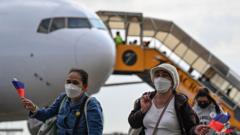
Asia's migrant workers debate if Gulf jobs are worth deadly risk of Iran war
📖 Full Retelling
📚 Related People & Topics

Asia
Continent
Asia ( AY-zhə, UK also AY-shə) is the largest continent in the world by both land area and population. It covers an area of more than 44 million square kilometres, about 30% of Earth's total land area and 8% of Earth's total surface area. The continent, which has long been home to the majority of ...

Bay
Recessed, coastal body of water connected to an ocean or lake
A bay is a recessed, coastal body of water that directly connects to a larger main body of water, such as an ocean, a lake, or another bay. A large bay is usually called a gulf, sea, sound, or bight. A cove is a small, circular bay with a narrow entrance.
List of wars involving Iran
This is a list of wars involving the Islamic Republic of Iran and its predecessor states. It is an unfinished historical overview.
Entity Intersection Graph
Connections for Asia:
Mentioned Entities
Deep Analysis
Why It Matters
This news matters because it highlights how geopolitical tensions directly impact vulnerable migrant populations who depend on Gulf employment for economic survival. Millions of Asian workers from countries like India, Pakistan, Bangladesh, Nepal, and the Philippines face impossible choices between financial necessity and personal safety. The potential conflict threatens remittance flows that sustain families and national economies across South and Southeast Asia, while also exposing workers to dangers beyond their control. This situation forces a reckoning about labor migration systems that prioritize economic benefits over human security.
Context & Background
- Over 10 million Asian migrant workers are employed in Gulf Cooperation Council countries (Saudi Arabia, UAE, Qatar, Kuwait, Oman, Bahrain), primarily in construction, domestic work, and service sectors.
- Remittances from Gulf workers constitute significant portions of GDP for sending countries—exceeding 10% for Nepal and around 6-8% for Pakistan, Bangladesh, and the Philippines.
- The Gulf region has experienced periodic instability including the Iran-Iraq War (1980-1988), Gulf War (1990-1991), and ongoing tensions between Iran and various Gulf states over regional influence and nuclear programs.
- Previous conflicts have led to emergency evacuations of migrant workers, such as during the 1990 Gulf War and 2006 Lebanon War, revealing systemic vulnerabilities in worker protection systems.
- Labor migration to the Gulf operates through the kafala (sponsorship) system that often restricts workers' rights and mobility, making evacuation decisions dependent on employer and government actions.
What Happens Next
Governments of labor-sending countries will likely issue travel advisories and establish emergency evacuation plans while negotiating with Gulf employers about worker protections. Recruitment agencies may face pressure to pause placements until security assessments improve. If tensions escalate, we could see temporary bans on new worker deployments similar to those implemented during COVID-19, followed by potential compensation disputes for affected families if casualties occur. International organizations like IOM and ILO may intervene to establish crisis protocols for migrant worker safety in conflict zones.
Frequently Asked Questions
Workers face limited economic opportunities at home with Gulf jobs offering 3-5 times higher wages. Many have taken loans to secure these positions and feel pressure to support extended families, making the financial risk of staying home greater than the physical risk of going.
Protections are minimal—most workers' visas tie them to specific employers who control their documentation. International conventions like the ILO Private Employment Agencies Convention lack universal adoption, leaving evacuation decisions to bilateral agreements between sending and receiving countries.
Economies would suffer immediate remittance declines while simultaneously needing to repatriate and support returning workers. Countries like Nepal and Bangladesh would face balance of payment pressures and increased unemployment, potentially requiring international financial assistance.
Limited alternatives exist—some may seek work in Southeast Asia or Eastern Europe at lower wages, while others might pursue dangerous irregular migration routes. Home countries would need to develop job creation programs, but these require years of investment and economic restructuring.
Agencies are monitoring government advisories while continuing placements, as their business models depend on steady worker flows. Some are offering optional insurance packages, but most responsibility ultimately falls on workers to assess personal risk versus economic need.