
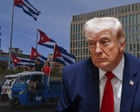
Donald Trump says 'Cuba's next' but what what does it mean? – video explainer
#Donald Trump #Cuba #sanctions #diplomacy #U.S. policy #video explainer #foreign relations
📌 Key Takeaways
- Donald Trump's statement 'Cuba's next' suggests potential future U.S. policy actions toward Cuba.
- The remark likely refers to tightening sanctions or reversing diplomatic relations established under Obama.
- It reflects ongoing political tensions and strategic considerations in U.S.-Cuba relations.
- The video explainer aims to clarify the implications and context behind Trump's ambiguous comment.
📖 Full Retelling
🏷️ Themes
U.S. Foreign Policy, Cuba Relations
📚 Related People & Topics

Cuba
Country in the Caribbean
Cuba, officially the Republic of Cuba, is an island country in the Caribbean. It comprises the eponymous main island as well as 4,195 islands, islets, and cays. Situated at the convergence of the Caribbean Sea, Gulf of Mexico, and Atlantic Ocean, Cuba is located east of the Yucatán Peninsula, south ...

Donald Trump
President of the United States (2017–2021; since 2025)
Donald John Trump (born June 14, 1946) is an American politician, media personality, and businessman who is the 47th president of the United States. A member of the Republican Party, he served as the 45th president from 2017 to 2021. Born into a wealthy New York City family, Trump graduated from the...
Entity Intersection Graph
Connections for Cuba:
Mentioned Entities
Deep Analysis
Why It Matters
This statement matters because it signals potential major shifts in U.S.-Cuba relations, which could affect millions of Cuban-Americans, impact Cuba's struggling economy, and reshape geopolitical dynamics in the Caribbean. It raises concerns about reversing diplomatic progress made during the Obama administration and could lead to renewed tensions between the two countries. The announcement affects Cuban families with relatives on the island, U.S. businesses exploring Cuban markets, and regional stability in Latin America.
Context & Background
- U.S.-Cuba relations were largely frozen from 1961 until 2015 when President Obama began normalizing diplomatic ties
- The Trump administration previously reinstated some travel and business restrictions that Obama had lifted
- Cuba has been under a U.S. economic embargo since 1962, making it one of the longest-standing trade embargoes in modern history
- Cuba's economy is heavily dependent on tourism and remittances from abroad, particularly from Cuban-Americans
- Previous U.S. administrations have used Cuba policy as a political tool to appeal to conservative Cuban-American voters in Florida
What Happens Next
Expect clarification from the White House on specific policy changes within weeks, potential new travel restrictions affecting U.S. citizens visiting Cuba, possible economic sanctions targeting Cuban government entities, and reactions from Cuban leadership and regional allies like Venezuela and Russia. Congressional hearings may follow to examine the implications of policy shifts.
Frequently Asked Questions
Trump likely signaled upcoming policy changes toward Cuba, possibly indicating a return to stricter sanctions or reversal of Obama-era normalization efforts. This could mean new travel restrictions, economic measures, or diplomatic actions against the Cuban government.
Cuban-American families may face renewed restrictions on travel to visit relatives and send remittances. Those with business interests in Cuba could encounter new regulatory hurdles, while politically it may influence voting patterns in key states like Florida.
The Obama administration normalized relations in 2015, reopening embassies and easing travel and business restrictions. Trump had already partially reversed these policies, but 'Cuba's next' suggests further escalation of pressure on the Cuban government.
Cuba will likely condemn the measures as continued U.S. aggression while seeking support from international allies. They may restrict cooperation on migration or security issues and potentially strengthen ties with China and Russia as countermeasures.
European, Canadian, and Latin American partners who have normalized relations with Cuba may criticize U.S. actions. Some might increase trade or diplomatic support for Cuba in response, potentially creating divisions in Western hemisphere relations.