
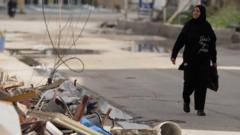
Fear and defiance in southern Lebanon city as Israel-Hezbollah war intensifies
#Lebanon #Israel #Hezbollah #war #southern Lebanon #conflict escalation #civilian fear #defiance
📌 Key Takeaways
- Residents of southern Lebanon are experiencing both fear and defiance as conflict escalates
- The Israel-Hezbollah war has intensified significantly in recent developments
- The situation is creating a tense atmosphere in southern Lebanese cities
- Civilian populations are caught in the middle of the military confrontation
📖 Full Retelling
🏷️ Themes
Middle East Conflict, Civilian Impact
📚 Related People & Topics
Hezbollah
Islamist movement and militant group based in Lebanon
Hezbollah is a Shia Islamist Lebanese political party and paramilitary group. Hezbollah's paramilitary wing is the Jihad Council, and its political wing is the Loyalty to the Resistance Bloc party in the Lebanese Parliament. Its armed strength was assessed to be equivalent to that of a medium-sized ...

Lebanon
Country in West Asia
Lebanon, officially the Lebanese Republic, is a country in the Levant region of West Asia. Situated at the crossroads of the Mediterranean Basin and the Arabian Peninsula, it is bordered by Syria to the north and east, Israel to the south, and the Mediterranean Sea to the west; Cyprus lies a short d...

Israel
Country in West Asia
Israel, officially the State of Israel, is a country in the Southern Levant region of West Asia. It is bordered by Lebanon to the north, Syria to the northeast, Jordan to the east, and Egypt to the southwest. Israel occupies the West Bank and the Gaza Strip of the Palestinian territories, as well as...
Entity Intersection Graph
Connections for Hezbollah:
View full profileMentioned Entities
Deep Analysis
Why It Matters
This intensifying conflict threatens to escalate into a full-scale regional war, directly endangering civilian populations in southern Lebanon and northern Israel while destabilizing the entire Middle East. The fighting affects not only combatants but also hundreds of thousands of displaced civilians on both sides of the border who face humanitarian crises. International shipping routes through the Mediterranean could be disrupted, impacting global trade, and the conflict risks drawing in other regional actors like Iran and potentially triggering broader international involvement.
Context & Background
- Hezbollah and Israel have engaged in periodic cross-border clashes since their 2006 war, which killed approximately 1,200 Lebanese and 160 Israelis
- Southern Lebanon has been a Hezbollah stronghold since the group's founding in the 1980s following Israel's invasion of Lebanon
- The current escalation began after Hamas's October 7 attack on Israel, with Hezbollah launching rockets in solidarity with Hamas
- UN Security Council Resolution 1701 (2006) called for disarmament of armed groups in Lebanon and deployment of UNIFIL peacekeepers, but Hezbollah has maintained its weapons
- Lebanon is experiencing its worst economic crisis in modern history, with the currency losing 98% of its value since 2019
What Happens Next
Diplomatic efforts by the U.S., France, and regional mediators will intensify in coming weeks to prevent full-scale war, with potential ceasefire talks if both sides show willingness. Military analysts warn of possible Israeli ground incursions into southern Lebanon if rocket attacks continue, which could trigger Hezbollah's full arsenal response. The situation may escalate further if Iran becomes more directly involved or if attacks spread to other fronts, potentially affecting international shipping in the Eastern Mediterranean.
Frequently Asked Questions
Hezbollah claims it's acting in solidarity with Hamas following Israel's military operation in Gaza, though the group has its own longstanding conflict with Israel dating back decades. The current escalation represents both ideological alignment with Palestinian causes and Hezbollah's strategic positioning as a regional counterweight to Israeli military power.
Tens of thousands of Lebanese civilians have been displaced from border villages, with many living in temporary shelters in schools or with relatives further north. Critical infrastructure including homes, hospitals, and agricultural land has been damaged by Israeli strikes, compounding Lebanon's existing economic crisis and creating a growing humanitarian emergency.
The intensity and duration of exchanges surpass most periods since the 2006 war, with both sides using more advanced weaponry and targeting deeper into each other's territory. The conflict is now explicitly linked to the Gaza war rather than being contained to the Israel-Lebanon border dynamic, increasing risks of regional spillover.
No, Hezbollah operates as a state-within-a-state with its own military capabilities independent of the Lebanese Armed Forces. The group holds significant political power in Lebanon's government but makes its own security decisions, particularly regarding conflict with Israel, creating a dual power structure that complicates diplomatic solutions.
Iran is Hezbollah's primary financial and military backer, providing weapons, training, and funding that make Hezbollah the region's most powerful non-state armed group. While Iran denies direct command of Hezbollah operations, the group's actions generally align with Iranian strategic interests in countering Israeli and U.S. influence in the Middle East.