
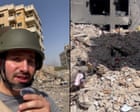
'Ghost town': Lebanon city deserted amid Israeli airstrikes – video dispatch
#Lebanon #Israeli airstrikes #ghost town #video dispatch #evacuation #cross-border tensions #deserted city
📌 Key Takeaways
- The city in Lebanon is largely deserted due to Israeli airstrikes, described as a 'ghost town'.
- A video dispatch provides visual evidence of the evacuation and destruction.
- The situation highlights escalating cross-border tensions between Israel and Lebanon.
- Residents have fled, leaving behind empty streets and abandoned homes.
📖 Full Retelling
🏷️ Themes
Conflict, Displacement
📚 Related People & Topics

Israeli Air Force
Aerial and space service branch of the Israel Defense Forces
The Israeli Air Force (IAF; Hebrew: זְרוֹעַ הָאֲוִיר וְהֶחָלָל, romanized: Zroa HaAvir VeHahalal, lit. 'Air and Space Arm', commonly known as חֵיל הָאֲוִיר, Kheil HaAvir, "Air Corps") operates as the aerial and space warfare branch of the Israel Defense Forces (IDF). It was founded on May 28, 1948,...

Lebanon
Country in West Asia
Lebanon, officially the Lebanese Republic, is a country in the Levant region of West Asia. Situated at the crossroads of the Mediterranean Basin and the Arabian Peninsula, it is bordered by Syria to the north and east, Israel to the south, and the Mediterranean Sea to the west; Cyprus lies a short d...
Entity Intersection Graph
Connections for Israeli Air Force:
View full profileMentioned Entities
Deep Analysis
Why It Matters
This news matters because it highlights the severe humanitarian impact of escalating cross-border violence between Israel and Hezbollah, which risks triggering a broader regional war. It affects Lebanese civilians forced to flee their homes, Israeli communities under rocket fire, and regional stability as international diplomatic efforts intensify. The displacement creates immediate humanitarian needs while threatening long-term economic collapse in southern Lebanon.
Context & Background
- Hezbollah and Israel have engaged in near-daily cross-border exchanges since October 2023, following Hamas's attack on Israel
- Southern Lebanon has experienced repeated conflicts, including the 2006 Israel-Hezbollah war that caused widespread destruction
- The UN peacekeeping force UNIFIL has been deployed in southern Lebanon since 1978 to monitor the border
- Lebanon is experiencing its worst economic crisis in modern history, with over 80% of the population living in poverty
- Previous conflicts have displaced hundreds of thousands of Lebanese civilians and caused significant infrastructure damage
What Happens Next
International diplomatic efforts will intensify, with US envoy Amos Hochstein expected to visit the region soon to mediate. Military analysts warn of potential escalation if airstrikes continue, possibly leading to wider Israeli ground operations. The UN will likely call for emergency sessions if displacement numbers increase significantly, while humanitarian organizations will ramp up aid delivery to affected areas.
Frequently Asked Questions
Israel says it is targeting Hezbollah military infrastructure in response to rocket attacks on northern Israel. The Israeli military claims these strikes are defensive measures to protect Israeli civilians from ongoing cross-border attacks.
According to UN estimates, over 90,000 people have been displaced from southern Lebanon since October 2023. The International Organization for Migration reports displacement numbers continue to rise as hostilities intensify.
Hezbollah is a Lebanese Shia political party and militant group that has been exchanging fire with Israel across the border. The group says it is acting in solidarity with Palestinians in Gaza while establishing 'rules of engagement' with Israel.
The conflict is devastating southern Lebanon's agricultural and tourism sectors, which were already crippled by the country's economic crisis. Border closures and destruction of infrastructure are further hampering trade and economic activity.
The US, France, and UN are engaged in intensive diplomacy to prevent full-scale war. The UN Security Council has expressed concern, while regional mediators are working to establish de-escalation mechanisms and reinforce UNIFIL's monitoring role.