
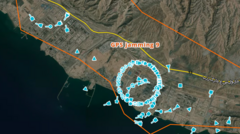
GPS jamming: The invisible battle in the Middle East
#GPS jamming #Middle East #electronic warfare #aviation disruption #navigation interference
📌 Key Takeaways
- GPS jamming incidents are increasing in the Middle East, affecting aviation and navigation.
- The jamming is part of an invisible electronic warfare conflict between regional actors.
- Civilian aircraft and shipping are experiencing significant disruptions and safety risks.
- The technology used for jamming is becoming more sophisticated and widespread.
🏷️ Themes
Electronic Warfare, Aviation Safety
📚 Related People & Topics

Middle East
Transcontinental geopolitical region
The Middle East is a geopolitical region encompassing the Arabian Peninsula, Egypt, Iran, Iraq, the Levant, and Turkey. The term came into widespread usage by Western European nations in the early 20th century as a replacement of the term Near East (both were in contrast to the Far East). The term ...
Entity Intersection Graph
Connections for Middle East:
Mentioned Entities
Deep Analysis
Why It Matters
GPS jamming in the Middle East threatens civilian aviation safety, disrupts maritime navigation, and undermines military operations across the region. This invisible electronic warfare affects commercial airlines flying through Middle Eastern airspace, shipping companies navigating strategic waterways, and regional military forces dependent on precision navigation. The escalating jamming represents a new front in regional conflicts where electronic warfare capabilities are being tested without direct confrontation, potentially creating dangerous situations for unaware civilian operators.
Context & Background
- GPS jamming involves transmitting radio signals that overpower or interfere with legitimate GPS signals, causing receivers to lose positioning data
- The Middle East has seen increasing electronic warfare capabilities as regional powers like Iran, Israel, and Gulf states develop sophisticated jamming and spoofing technologies
- Previous incidents include jamming affecting commercial flights over Iraq and Syria, and maritime navigation in the Persian Gulf and Red Sea
- GPS disruption has become a tool in regional proxy conflicts, with various actors using it to protect military assets or disrupt adversaries
- The vulnerability of civilian GPS infrastructure has been documented since at least 2018 when researchers first reported widespread spoofing in the region
What Happens Next
Increased reporting requirements for airlines experiencing navigation issues, potential rerouting of commercial flights away from high-risk areas, development of alternative navigation systems by affected nations, likely diplomatic discussions about electronic warfare norms, and possible counter-jamming technology deployment by military and commercial operators in the coming months.
Frequently Asked Questions
GPS jamming works by broadcasting radio signals on the same frequency as GPS satellites, overwhelming the weaker satellite signals with noise. This prevents GPS receivers from calculating accurate positions, causing them to display incorrect locations or lose signal entirely. More sophisticated spoofing can even feed false position data to receivers.
Commercial airlines flying through Iraqi, Syrian, and eastern Mediterranean airspace report frequent disruptions. Maritime traffic in the Persian Gulf, Strait of Hormuz, and Red Sea experiences regular interference. Military operations throughout the region, particularly in conflict zones, face systematic GPS denial efforts.
Modern aircraft have multiple navigation systems including inertial navigation and ground-based radio beacons as backups. However, pilots still rely heavily on GPS for precise navigation, especially in remote areas. Airlines are increasingly training crews to recognize and respond to navigation system failures caused by jamming.
The region hosts multiple ongoing conflicts where electronic warfare provides deniable ways to disrupt adversaries. Strategic waterways and air corridors see heavy military and commercial traffic, making them attractive targets for testing jamming capabilities. Several regional powers have invested heavily in electronic warfare as part of their military modernization.
International aviation regulations require states to ensure safe navigation in their airspace, but electronic warfare activities often occur in conflict zones with limited governance. There are no specific international treaties banning GPS jamming, though it violates principles of aviation safety. Attribution remains difficult, allowing perpetrators to operate with plausible deniability.