
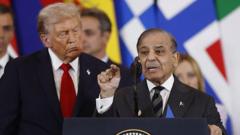
How Pakistan won over Trump to become an unlikely mediator
📖 Full Retelling
📚 Related People & Topics

Taliban
Islamist militant organization in control of Afghanistan
The Taliban, which also refers to itself by its state name, the Islamic Emirate of Afghanistan, is an Afghan political and militant organization with an ideology comprising elements of the Deobandi movement of Islamic fundamentalism and Pashtun nationalism. It ruled approximately 90% of Afghanistan ...

Pakistan
Country in South Asia
Pakistan, officially the Islamic Republic of Pakistan, is a country in South Asia. It is the fifth-most populous country, with a population of over 241.5 million, having the second-largest Muslim population as of 2023. Islamabad is the nation's capital, while Karachi is its largest city and financia...
Afghanistan
Country in Central and South Asia
Afghanistan, officially the Islamic Emirate of Afghanistan, is a landlocked country located at the crossroads of Central and South Asia. It is bordered by Pakistan to the east and south, Iran to the west, Turkmenistan to the northwest, Uzbekistan to the north, Tajikistan to the northeast, and China ...

Donald Trump
President of the United States (2017–2021; since 2025)
Donald John Trump (born June 14, 1946) is an American politician, media personality, and businessman who is the 47th president of the United States. A member of the Republican Party, he served as the 45th president from 2017 to 2021. Born into a wealthy New York City family, Trump graduated from the...
Entity Intersection Graph
Connections for Taliban:
Mentioned Entities
Deep Analysis
Why It Matters
This development matters because it signals a significant shift in U.S.-Pakistan relations, which have been strained for years over counterterrorism concerns. It affects regional stability in South Asia, particularly regarding Afghanistan peace talks and India-Pakistan tensions. The change impacts U.S. foreign policy strategy in the region and could alter power dynamics between Pakistan, India, and Afghanistan.
Context & Background
- U.S.-Pakistan relations deteriorated significantly after the 2011 raid that killed Osama bin Laden in Pakistan
- Pakistan has long been accused by U.S. officials of providing safe haven to Taliban militants while receiving billions in U.S. aid
- The Trump administration had previously suspended security assistance to Pakistan in 2018, accusing the country of not doing enough against terrorists
- Pakistan shares a contentious border with Afghanistan and has historical influence over Taliban factions
- India has traditionally been closer to recent U.S. administrations, creating a triangular tension in U.S. South Asia policy
What Happens Next
Pakistan will likely continue mediating between the U.S. and Taliban in Afghanistan peace negotiations. The country may seek restoration of suspended U.S. security assistance and increased economic cooperation. Regional dynamics could shift as Pakistan leverages its renewed diplomatic position, potentially affecting India-Pakistan relations and the broader South Asian strategic balance.
Frequently Asked Questions
Pakistan's mediator role is surprising because the Trump administration had previously taken a hardline stance against Pakistan, cutting security aid and accusing the country of harboring terrorists. The shift represents a dramatic turnaround in diplomatic relations and strategy.
Pakistan's mediation could accelerate Afghanistan peace negotiations as they have historical ties and influence with Taliban factions. This might lead to more substantive talks between the U.S. and Taliban, potentially bringing the long conflict closer to resolution.
India will likely view this development with concern as it strengthens Pakistan's regional position. New Delhi may increase diplomatic efforts to maintain its relationship with Washington while watching for any shift in U.S. policy regarding Kashmir or bilateral disputes.
Pakistan likely demonstrated increased cooperation on counterterrorism and proved instrumental in facilitating talks with the Taliban. Strategic necessity for advancing Afghanistan peace negotiations probably outweighed previous frustrations with Pakistan's counterterrorism efforts.
While U.S.-India relations remain strong based on shared democratic values and strategic interests, this development may create temporary tensions. Washington will need to balance its relationships with both South Asian rivals while pursuing its Afghanistan objectives.