
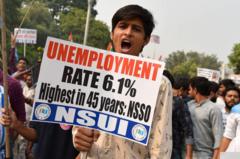
India's young are more educated than ever. So why are so many jobless?
#India #youth #education #unemployment #job market #economic issues #employment crisis
📌 Key Takeaways
- India's youth are achieving higher education levels than previous generations.
- Despite increased education, unemployment among young people remains high.
- The article explores the mismatch between education and job market demands.
- Structural economic issues may be contributing to the youth unemployment crisis.
📖 Full Retelling
🏷️ Themes
Youth Unemployment, Education Gap
📚 Related People & Topics

India
Country in South Asia
India, officially the Republic of India, is a country in South Asia. It is the seventh-largest country by area; the most populous country since 2023; and, since its independence in 1947, the world's most populous democracy. Bounded by the Indian Ocean on the south, the Arabian Sea on the southwest,...
Entity Intersection Graph
Connections for India:
Mentioned Entities
Deep Analysis
Why It Matters
This issue matters because India has the world's largest youth population, with over 65% under 35 years old, making youth unemployment a critical economic and social challenge. High unemployment among educated youth represents wasted human capital and threatens India's demographic dividend, potentially leading to social unrest and economic stagnation. The problem affects millions of educated young Indians who face underemployment or unemployment despite their qualifications, creating frustration and brain drain as skilled workers seek opportunities abroad. This situation impacts India's economic growth potential and could undermine the country's aspirations to become a global economic powerhouse.
Context & Background
- India's literacy rate has increased from 65% in 2001 to over 77% in 2022, with significant growth in higher education enrollment
- The country's formal job creation has lagged behind its expanding workforce, with only about 10% of India's workforce employed in the formal sector
- India's economy has experienced rapid growth averaging 6-7% annually over the past decade, but this growth has been concentrated in capital-intensive rather than labor-intensive sectors
- Previous government initiatives like 'Make in India' and 'Skill India' have aimed to boost manufacturing and vocational training but have shown limited success in job creation
- The COVID-19 pandemic exacerbated unemployment issues, with youth unemployment reaching record highs during lockdown periods
What Happens Next
The government is likely to introduce new employment-focused policies ahead of upcoming elections, potentially including incentives for labor-intensive industries and expanded apprenticeship programs. Educational reforms may accelerate to better align curricula with market needs, with increased emphasis on vocational and technical skills. Private sector pressure may grow for labor law reforms to make hiring more flexible, though this faces political resistance. International companies may increase investment in India's tech sector, creating some high-skilled jobs but insufficient to address mass unemployment.
Frequently Asked Questions
There's a mismatch between education system outputs and labor market needs, with many graduates lacking practical skills employers seek. Additionally, India's economic growth has been concentrated in sectors like IT and services that don't create enough jobs for the millions entering the workforce annually. The formal job market remains small relative to the population, forcing many educated youth into informal or underpaid work.
The technology sector, particularly IT services and startups, creates high-skilled jobs but employs relatively few people compared to the workforce size. Manufacturing has shown limited growth due to automation and global competition, while agriculture continues to shed jobs. Gig economy platforms provide some opportunities but often without job security or benefits.
Many Indian universities emphasize theoretical knowledge over practical skills, leaving graduates unprepared for workplace demands. There's also an oversupply of graduates in certain fields like humanities and commerce, while technical and vocational education remains underdeveloped. The education system hasn't kept pace with rapidly changing industry requirements, particularly in emerging technologies.
The government has launched initiatives like the National Education Policy 2020 to reform education and emphasize vocational training. Various skill development programs aim to train youth for specific industries, and production-linked incentive schemes attempt to boost manufacturing employment. However, these programs face implementation challenges and haven't yet created jobs at the needed scale.
India's youth unemployment rate is significantly higher than many developing and developed economies, despite having one of the world's fastest-growing major economies. The problem is particularly acute for educated youth, with unemployment rates for graduates being multiple times higher than for those with only primary education. This contrasts with countries that have better education-to-employment pipelines.