
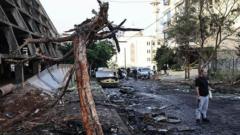
Israel intensifies Lebanon attacks and hits areas not in Hezbollah's control
📚 Related People & Topics
Hezbollah
Islamist movement and militant group based in Lebanon
Hezbollah is a Shia Islamist Lebanese political party and paramilitary group. Hezbollah's paramilitary wing is the Jihad Council, and its political wing is the Loyalty to the Resistance Bloc party in the Lebanese Parliament. Its armed strength was assessed to be equivalent to that of a medium-sized ...

Lebanon
Country in West Asia
Lebanon, officially the Lebanese Republic, is a country in the Levant region of West Asia. Situated at the crossroads of the Mediterranean Basin and the Arabian Peninsula, it is bordered by Syria to the north and east, Israel to the south, and the Mediterranean Sea to the west; Cyprus lies a short d...

Israel
Country in West Asia
Israel, officially the State of Israel, is a country in the Southern Levant region of West Asia. It is bordered by Lebanon to the north, Syria to the northeast, Jordan to the east, and Egypt to the southwest. Israel occupies the West Bank and the Gaza Strip of the Palestinian territories, as well as...
Entity Intersection Graph
Connections for Hezbollah:
View full profileMentioned Entities
Deep Analysis
Why It Matters
This escalation matters because it expands the conflict beyond direct military targets, increasing risks to Lebanese civilians and infrastructure not previously involved. It affects regional stability by potentially drawing in other actors beyond Hezbollah, and impacts diplomatic efforts to contain the Israel-Hezbollah conflict. The broadening of strikes could lead to greater international condemnation and complicate ceasefire negotiations.
Context & Background
- Hezbollah and Israel have engaged in cross-border exchanges since October 2023, following Hamas's attack on Israel
- Previous Israeli strikes in Lebanon have primarily targeted Hezbollah military infrastructure and personnel in southern Lebanon
- The UN-brokered ceasefire between Israel and Hezbollah in 2006 has been increasingly violated in recent months
- Lebanon's government has limited control over Hezbollah's military activities in southern regions
- Israel has repeatedly warned it will not tolerate Hezbollah's presence near its northern border
What Happens Next
Expect increased diplomatic pressure from the US and European nations to de-escalate the situation within the next week. Lebanon may file a formal complaint with the UN Security Council. Hezbollah will likely retaliate with strikes deeper into Israeli territory, potentially targeting civilian areas. The risk of full-scale conflict between Israel and Lebanon increases significantly if strikes continue to expand beyond traditional conflict zones.
Frequently Asked Questions
Israel may be attempting to pressure the Lebanese government to restrain Hezbollah, or responding to intelligence about Hezbollah operations in new areas. This could also represent a strategic shift to degrade Hezbollah's broader support networks across Lebanon.
Civilians in previously unaffected areas now face direct danger from airstrikes, potentially causing new displacement and casualties. Critical infrastructure outside conflict zones may be damaged, affecting essential services across Lebanon.
Hezbollah will probably escalate its own attacks on northern Israel, potentially targeting larger population centers. The group may also mobilize more of its forces and consider launching more sophisticated weapon systems against Israeli targets.
The expansion of strikes increases the risk of drawing Syria and Iran more directly into the conflict. Other regional actors may feel compelled to take sides, potentially destabilizing the already fragile security situation across the Middle East.
This escalation complicates ongoing mediation efforts by the US and France. It may lead to increased international condemnation of Israel and calls for UN intervention, while making future ceasefire negotiations more difficult to achieve.