
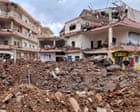
Israel kills dozens in Lebanon after failed mission to find pilot’s remains
#Israel #Lebanon #pilot remains #military operation #casualties #strikes #Middle East conflict
📌 Key Takeaways
- Israeli military operation in Lebanon aimed to recover pilot remains but failed
- Dozens of Lebanese casualties reported from the Israeli strikes
- Mission's failure escalates regional tensions between Israel and Lebanon
- Incident highlights ongoing conflict and military actions in the Middle East
📖 Full Retelling
🏷️ Themes
Military Conflict, Regional Tensions
📚 Related People & Topics

List of modern conflicts in the Middle East
List of Middle Eastern conflicts since 1914
This is a list of modern conflicts ensuing in the geographic and political region known as the Middle East. The "Middle East" is traditionally defined as the Fertile Crescent (Mesopotamia), Levant, and Egypt and neighboring areas of Arabia, Anatolia and Iran. It currently encompasses the area from E...

Lebanon
Country in West Asia
Lebanon, officially the Lebanese Republic, is a country in the Levant region of West Asia. Situated at the crossroads of the Mediterranean Basin and the Arabian Peninsula, it is bordered by Syria to the north and east, Israel to the south, and the Mediterranean Sea to the west; Cyprus lies a short d...

Israel
Country in West Asia
Israel, officially the State of Israel, is a country in the Southern Levant region of West Asia. It is bordered by Lebanon to the north, Syria to the northeast, Jordan to the east, and Egypt to the southwest. Israel occupies the West Bank and the Gaza Strip of the Palestinian territories, as well as...
Entity Intersection Graph
Connections for List of modern conflicts in the Middle East:
Mentioned Entities
Deep Analysis
Why It Matters
This incident represents a significant escalation in cross-border violence between Israel and Lebanon, risking broader regional conflict. It directly affects Lebanese civilians in the targeted areas, Israeli military families seeking closure, and regional stability. The high casualty count from a single operation could trigger retaliatory actions from Hezbollah or other militant groups in Lebanon. This also impacts diplomatic efforts to maintain the fragile ceasefire along the Israel-Lebanon border.
Context & Background
- Israel and Lebanon have been in a formal state of war since 1948, with periodic conflicts including the 2006 Israel-Hezbollah War
- Hezbollah maintains significant military presence in southern Lebanon and has engaged in periodic cross-border attacks against Israel
- Israel has conducted multiple operations over decades to recover remains of soldiers, viewing this as a sacred national duty
- The Israel-Lebanon border has seen increased tensions since the October 2023 Hamas-Israel conflict began
- Previous Israeli operations in Lebanon have sometimes triggered wider military confrontations with Hezbollah forces
What Happens Next
Hezbollah is likely to announce retaliatory strikes against Israeli military positions in the coming days. The UN Interim Force in Lebanon (UNIFIL) will likely increase patrols and call for restraint from both sides. Israel may face international condemnation at the UN Security Council for the high civilian casualty count. Additional Israeli operations to locate the pilot's remains could follow, potentially leading to further escalation.
Frequently Asked Questions
Israel places extremely high value on recovering soldiers' remains for religious, moral, and national unity reasons. The military considers it a sacred duty to bring all personnel home, regardless of risk or cost, which drives these high-stakes operations.
This will severely damage already tense relations and likely lead to increased cross-border attacks. It undermines diplomatic efforts to maintain calm along the Blue Line border and could push Lebanon toward stronger alignment with Iran-backed groups.
The article doesn't specify, but historically Israeli pilots have been lost over Lebanon during various conflicts since the 1980s. Previous losses occurred during the 1982 Lebanon War, 2006 war, and during surveillance missions over hostile territory.
While possible, both sides have shown restraint in recent years to avoid all-out war. However, miscalculation or escalation spiral following this incident could potentially trigger broader conflict, especially if Hezbollah responds with major attacks.
Depending on circumstances, this could raise concerns about proportionality under international humanitarian law if civilian casualties were excessive relative to military objectives. The operation in another country's territory without consent also raises sovereignty issues under the UN Charter.