
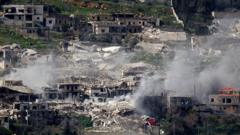
Israeli troops push into Lebanon for yet another war with Iran's proxy Hezbollah
#Israel #Lebanon #Hezbollah #Iran #war #troops #proxy #escalation
📌 Key Takeaways
- Israeli military forces have advanced into Lebanese territory.
- The conflict involves direct engagement with Hezbollah forces.
- Hezbollah is identified as a proxy group supported by Iran.
- This marks another escalation in ongoing regional hostilities.
📖 Full Retelling
🏷️ Themes
Military Conflict, Regional Tensions
📚 Related People & Topics
Hezbollah
Islamist movement and militant group based in Lebanon
Hezbollah is a Shia Islamist Lebanese political party and paramilitary group. Hezbollah's paramilitary wing is the Jihad Council, and its political wing is the Loyalty to the Resistance Bloc party in the Lebanese Parliament. Its armed strength was assessed to be equivalent to that of a medium-sized ...

Iran
Country in West Asia
# Iran **Iran**, officially the **Islamic Republic of Iran** and historically known as **Persia**, is a sovereign country situated in West Asia. It is a major regional power, ranking as the 17th-largest country in the world by both land area and population. Combining a rich historical legacy with a...

Lebanon
Country in West Asia
Lebanon, officially the Lebanese Republic, is a country in the Levant region of West Asia. Situated at the crossroads of the Mediterranean Basin and the Arabian Peninsula, it is bordered by Syria to the north and east, Israel to the south, and the Mediterranean Sea to the west; Cyprus lies a short d...

Israel
Country in West Asia
Israel, officially the State of Israel, is a country in the Southern Levant region of West Asia. It is bordered by Lebanon to the north, Syria to the northeast, Jordan to the east, and Egypt to the southwest. Israel occupies the West Bank and the Gaza Strip of the Palestinian territories, as well as...
Entity Intersection Graph
Connections for Hezbollah:
View full profileMentioned Entities
Deep Analysis
Why It Matters
This development matters because it represents a significant escalation in regional tensions that could spiral into a broader Middle East conflict. It directly affects civilians in both Israel and Lebanon who face immediate security threats, while also impacting global energy markets and international diplomatic relations. The confrontation between Israel and Hezbollah, as Iran's most powerful regional proxy, tests the limits of deterrence and risks drawing in other actors, potentially destabilizing an already volatile region.
Context & Background
- Israel and Hezbollah last fought a major war in 2006 that lasted 34 days and resulted in over 1,000 Lebanese and 165 Israeli deaths
- Hezbollah has amassed an estimated 150,000 rockets and missiles since 2006, creating what experts call the largest non-state military arsenal in the world
- The current tensions have been building since October 2023 with near-daily cross-border exchanges following Hamas's attack on Israel
- Lebanon is experiencing its worst economic crisis in modern history, with the currency losing 98% of its value since 2019
- Iran has provided Hezbollah with advanced weapons and funding for decades as part of its 'axis of resistance' against Israel and Western influence
What Happens Next
International diplomatic efforts will intensify, with the U.S., France, and regional mediators attempting to broker a ceasefire before the conflict expands further. Military analysts predict Israel will attempt limited ground operations to push Hezbollah forces north of the Litani River (approximately 30 km from the border), while Hezbollah will likely respond with increased rocket barrages targeting northern Israeli cities. The coming weeks will determine whether this remains a contained border conflict or escalates into full-scale war, with key dates including upcoming UN Security Council emergency sessions and planned diplomatic visits by U.S. and European envoys.
Frequently Asked Questions
Hezbollah receives substantial funding, weapons, and training directly from Iran's Islamic Revolutionary Guard Corps. The group was founded with Iranian support in the 1980s and operates as a key component of Iran's regional strategy, often coordinating with other Iranian-backed militias across the Middle East.
Israel aims to push Hezbollah forces away from its northern border to restore security for approximately 60,000 displaced Israelis. Secondary objectives include degrading Hezbollah's military capabilities and reestablishing deterrence to prevent future attacks from Lebanon.
The current conflict involves more advanced weapons systems on both sides, including precision-guided missiles and drone warfare capabilities. Additionally, Hezbollah has significantly expanded its military experience through fighting in Syria's civil war, while Israel has developed advanced missile defense systems like Iron Dome and David's Sling.
The U.S. is attempting to prevent full-scale war through diplomatic channels while continuing military support to Israel. American officials are working with French and Qatari mediators to negotiate a de-escalation, even as the U.S. Navy positions assets in the Eastern Mediterranean as a deterrent.
While Israel's Iron Dome and other defense systems can intercept many rockets, experts warn that Hezbollah's estimated 150,000-projectile arsenal could overwhelm defenses in a major conflict. Hezbollah has also acquired precision-guided missiles that could target critical infrastructure with greater accuracy.
A full-scale war would devastate Lebanon's already collapsed economy, potentially causing complete state failure. The conflict has already disrupted tourism and agricultural exports from southern Lebanon, while further destruction of infrastructure would make recovery nearly impossible without massive international aid.