
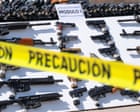
Majority of Mexican cartels’ guns come from US, Sheinbaum says in response to Trump claims
#Mexican cartels #US firearms #Claudia Sheinbaum #Donald Trump #arms trafficking #gun control #US-Mexico relations
📌 Key Takeaways
- Mexican President-elect Claudia Sheinbaum asserts most cartel firearms originate from the US.
- Sheinbaum's statement directly counters claims made by former US President Donald Trump.
- The issue highlights cross-border arms trafficking as a key security concern.
- The exchange underscores ongoing US-Mexico tensions over gun control and cartel violence.
📖 Full Retelling
🏷️ Themes
Cross-border security, Political dispute
📚 Related People & Topics

Claudia Sheinbaum
President of Mexico since 2024
Claudia Sheinbaum Pardo (born 24 June 1962) is a Mexican politician, energy and climate change scientist, and academic who has been serving as the 66th president of Mexico since 2024. She is the first woman and the first Jewish person to hold the office. A member of the National Regeneration Movemen...

Donald Trump
President of the United States (2017–2021; since 2025)
Donald John Trump (born June 14, 1946) is an American politician, media personality, and businessman who is the 47th president of the United States. A member of the Republican Party, he served as the 45th president from 2017 to 2021. Born into a wealthy New York City family, Trump graduated from the...
Drug cartel
Group drug trafficking operations
A drug cartel is a criminal organization composed of independent drug lords who collude with each other in order to improve their profits and dominate the illegal drug trade. Drug cartels form with the purpose of controlling the supply of the illegal drug trade and maintaining prices at a high lev...
Entity Intersection Graph
Connections for Claudia Sheinbaum:
View full profileMentioned Entities
Deep Analysis
Why It Matters
This statement matters because it directly addresses the long-standing debate about cross-border weapons trafficking and its role in fueling Mexico's drug war violence. It affects bilateral relations between the U.S. and Mexico, law enforcement agencies on both sides of the border, and communities impacted by cartel violence. The claim challenges political narratives about the source of Mexico's security problems and could influence future policy discussions about gun control and border security measures.
Context & Background
- The U.S. has been the primary source of firearms for Mexican cartels for decades, with studies showing 70-90% of traced weapons originate from American dealers
- The 2006 Mérida Initiative established U.S.-Mexico security cooperation, but weapons trafficking remains a persistent challenge
- Mexico has much stricter gun laws than the U.S., with only one legal gun store in the entire country operated by the military
- Previous U.S. administrations have implemented programs like Operation Fast and Furious to track weapons, which became controversial when guns were lost
- Cartel violence has claimed over 350,000 lives in Mexico since 2006 when the government launched its military campaign against drug organizations
What Happens Next
This exchange will likely continue during the U.S. presidential campaign, with potential policy discussions about renewing the assault weapons ban or strengthening border gun trafficking enforcement. Bilateral meetings between U.S. and Mexican officials may address this issue, particularly if Trump wins the election. The Mexican government may push for more U.S. cooperation on tracking weapons purchases near the border, while U.S. lawmakers could propose legislation to increase penalties for straw purchasers.
Frequently Asked Questions
U.S. government data from firearm tracing programs consistently shows that 70-90% of weapons recovered in Mexico and submitted for tracing originate from American dealers. The ATF's eTrace system has documented thousands of weapons purchased legally in border states then smuggled into Mexico through various trafficking networks.
Mexico's northern border spans nearly 2,000 miles with hundreds of legal crossing points, making comprehensive inspection impossible. Cartels use sophisticated smuggling techniques including hidden compartments in vehicles, tunnels, and corruption of officials. The sheer volume of legitimate cross-border traffic creates significant challenges for interdiction efforts.
Cartels primarily use 'straw purchasers' - individuals who legally buy weapons in U.S. border states then transfer them to traffickers. They also exploit gun show loopholes in some states and purchase from corrupt dealers. Weapons are typically transported in vehicles with hidden compartments or through established smuggling routes alongside drug shipments.
The U.S. has implemented programs like eTrace for weapon tracking, increased penalties for straw purchasing, and conducted joint operations with Mexican authorities. However, efforts have been inconsistent, with programs like Operation Fast and Furious becoming controversial when weapons were allowed to 'walk' into Mexico to track cartel networks, resulting in some being used in crimes.
Weapons trafficking has been a persistent diplomatic irritant, with Mexican officials regularly urging stronger U.S. gun control measures. The issue creates tension between Mexico's desire for action and U.S. political constraints around Second Amendment rights. Cooperation fluctuates based on which administrations are in power and their priorities regarding border security and drug policy.