
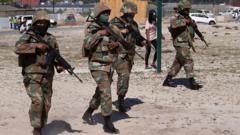
South African army arrive in crime hotspots to help tackle gangs
📚 Related People & Topics
South Africa
Country in Southern Africa
South Africa, officially the Republic of South Africa (RSA), is the southernmost country in Africa. Its nine provinces are bounded to the south by 2,798 kilometres (1,739 miles) of coastline that stretches along the South Atlantic and Indian Ocean; to the north by the neighbouring countries of Namib...
Entity Intersection Graph
Connections for South Africa:
Mentioned Entities
Deep Analysis
Why It Matters
This deployment matters because it signals a significant escalation in South Africa's approach to combating violent crime, which has reached crisis levels in certain communities. It directly affects residents of high-crime areas who have endured gang violence, extortion, and insecurity in their daily lives. The military intervention also impacts policing strategies and raises questions about the appropriate use of armed forces for domestic law enforcement. This move could either restore public confidence in state security or potentially lead to human rights concerns if military tactics prove excessive for civilian contexts.
Context & Background
- South Africa has one of the highest violent crime rates globally, with gang violence particularly entrenched in areas like the Cape Flats in Cape Town.
- The South African Police Service (SAPS) has historically struggled with capacity, corruption, and effectiveness in combating organized crime networks.
- Previous military deployments to assist police occurred during COVID-19 lockdowns (2020-2021) and during the July 2021 civil unrest, setting precedents for domestic military use.
- Gang violence in South Africa is often linked to socioeconomic inequality, drug trafficking networks, and historical spatial segregation from apartheid.
What Happens Next
In the coming weeks, observers will monitor whether the military presence reduces violent incidents and arrests key gang figures. Legal challenges may arise regarding the scope and duration of military powers in civilian areas. The government will likely face pressure to define an exit strategy and demonstrate how this temporary measure leads to sustainable policing improvements. International human rights organizations may scrutinize the operation for potential abuses.
Frequently Asked Questions
The army is being deployed because police forces are perceived as overwhelmed and outgunned by well-armed gang networks in specific hotspots. Military units bring superior firepower, intelligence capacity, and a show of force that may deter gang activities more effectively than regular policing.
The deployment duration hasn't been specified but is likely temporary, intended as a shock intervention rather than permanent military occupation. Previous similar operations lasted several months, with extensions depending on security assessments and political decisions.
Risks include potential human rights violations, militarization of civilian spaces, and confusion between combat and law enforcement roles. Military training focuses on neutralizing enemies rather than community policing, which could lead to excessive force or erosion of public trust.
While not specified in this brief article, typical South African crime hotspots include townships and informal settlements in Cape Town (especially the Cape Flats), parts of Johannesburg, and Durban. These areas experience high rates of gang-related murders, drug trafficking, and extortion.