
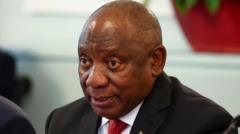
South Africa's exclusion from G7 summit no surprise, says Ramaphosa
📖 Full Retelling
📚 Related People & Topics
South Africa
Country in Southern Africa
South Africa, officially the Republic of South Africa (RSA), is the southernmost country in Africa. Its nine provinces are bounded to the south by 2,798 kilometres (1,739 miles) of coastline that stretches along the South Atlantic and Indian Ocean; to the north by the neighbouring countries of Namib...

Cyril Ramaphosa
President of South Africa since 2018
Matamela Cyril Ramaphosa ( RAM-ə-FAW-sə or RAH-mə-POH-sə; born 17 November 1952) is a South African businessman and politician serving as the president of South Africa since 2018. A former anti-apartheid activist and trade union leader, Ramaphosa is also the president of the African National Congr...
Entity Intersection Graph
Connections for South Africa:
Mentioned Entities
Deep Analysis
Why It Matters
This news matters because it highlights South Africa's shifting geopolitical position and its complex relationship with Western powers. It affects South Africa's international standing, its economic partnerships, and its ability to influence global governance. The exclusion reflects broader tensions between Western nations and countries maintaining neutral or alternative diplomatic stances, particularly regarding conflicts like Russia's invasion of Ukraine. This development could impact South Africa's trade relations, investment flows, and its role in multilateral forums like BRICS and the African Union.
Context & Background
- South Africa has maintained a non-aligned foreign policy stance regarding the Russia-Ukraine war, refusing to condemn Russia's invasion
- The G7 (Group of Seven) consists of Canada, France, Germany, Italy, Japan, the United Kingdom, and the United States, representing major advanced economies
- South Africa has previously participated in G7 outreach sessions and summits as a guest nation, particularly during the 2010s
- South Africa is a founding member of BRICS (Brazil, Russia, India, China, South Africa), positioning itself as part of an alternative geopolitical bloc
- The country faces significant domestic challenges including energy crises, high unemployment, and economic stagnation affecting its global influence
What Happens Next
South Africa will likely intensify engagement with BRICS partners ahead of the 2024 BRICS summit. The country may seek to strengthen ties with other Global South nations through forums like the African Union and G20. Diplomatic efforts to repair relations with G7 nations will continue, but substantive policy shifts regarding Ukraine appear unlikely before South Africa's 2024 elections. The exclusion may influence investment decisions and trade negotiations with Western partners in coming months.
Frequently Asked Questions
South Africa was excluded primarily due to its neutral stance on Russia's invasion of Ukraine and refusal to align with Western sanctions. The country's continued engagement with Russia through BRICS and other forums has strained relations with G7 nations who view this as undermining international norms.
The exclusion could impact foreign investment from G7 nations and complicate trade relations, particularly with the EU and UK. However, South Africa may seek to offset this through strengthened economic ties with BRICS partners and other Global South nations.
No, South Africa has regularly participated in G7 outreach sessions as a guest nation, particularly during the Obama and early Trump administrations. This represents a significant shift in diplomatic engagement patterns with the Western economic bloc.
President Ramaphosa stated the exclusion was 'no surprise,' suggesting the government anticipated this outcome given its foreign policy positions. Officials have emphasized South Africa's commitment to independent foreign policy and multilateral engagement through alternative forums.
The exclusion could strengthen South Africa's positioning as an independent voice in African diplomacy, potentially increasing its credibility among nations seeking alternatives to Western-dominated governance structures. However, it may also reduce its effectiveness as a bridge between Africa and G7 nations.