
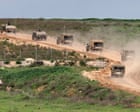
The Guardian view on Israel’s war in Lebanon: allies must not accept a repeat of the crimes in Gaza | Editorial
📖 Full Retelling
📚 Related People & Topics

The Guardian
British national daily newspaper
The Guardian is a British daily newspaper. It was founded in Manchester in 1821 as The Manchester Guardian and changed its name in 1959, followed by a move to London. Along with its sister paper, The Guardian Weekly, The Guardian is part of the Guardian Media Group, owned by the Scott Trust Limited.

Lebanon
Country in West Asia
Lebanon, officially the Lebanese Republic, is a country in the Levant region of West Asia. Situated at the crossroads of the Mediterranean Basin and the Arabian Peninsula, it is bordered by Syria to the north and east, Israel to the south, and the Mediterranean Sea to the west; Cyprus lies a short d...

Israel
Country in West Asia
Israel, officially the State of Israel, is a country in the Southern Levant region of West Asia. It is bordered by Lebanon to the north, Syria to the northeast, Jordan to the east, and Egypt to the southwest. Israel occupies the West Bank and the Gaza Strip of the Palestinian territories, as well as...
Entity Intersection Graph
Connections for Gaza:
Mentioned Entities
Deep Analysis
Why It Matters
This editorial addresses the escalating conflict between Israel and Hezbollah in Lebanon, warning that it could mirror the devastating humanitarian crisis seen in Gaza. It matters because it involves regional stability, international law violations, and potential mass displacement of civilians. The analysis calls on Western allies to prevent another humanitarian catastrophe, affecting Lebanese civilians, Israeli border communities, and global diplomatic relations.
Context & Background
- Hezbollah and Israel have engaged in periodic cross-border clashes since the 2006 Lebanon War, which killed over 1,000 Lebanese and 165 Israelis.
- The current escalation began after Hamas's October 7 attack on Israel, with Hezbollah launching rockets in solidarity with Hamas.
- Lebanon is experiencing severe economic crisis, with over 80% of the population living in poverty, making it vulnerable to further conflict.
- Israel has conducted airstrikes deep into Lebanese territory, raising fears of a full-scale war similar to 2006.
- The United States and other Western countries provide military and diplomatic support to Israel, influencing its strategic decisions.
What Happens Next
Diplomatic efforts by the U.S. and France are expected to intensify to broker a ceasefire before the conflict expands. If negotiations fail, Israel may launch a ground invasion into southern Lebanon, leading to widespread destruction and displacement. The situation could escalate regionally, drawing in Iran or other actors, with the UN warning of a potential 'apocalyptic' war.
Frequently Asked Questions
Hezbollah, an Iran-backed militant group and political party in Lebanon, sees itself as a resistance force against Israel. It has launched attacks in solidarity with Hamas following the Gaza war, aiming to pressure Israel on multiple fronts.
Western allies, particularly the U.S., provide military aid and diplomatic support to Israel. The editorial argues they have leverage to restrain Israel from escalating the conflict and should use it to prevent humanitarian crimes.
The current conflict involves more advanced weaponry, deeper airstrikes into Lebanon, and occurs alongside the Gaza war. Hezbollah is also stronger militarily than in 2006, raising the risk of a more destructive confrontation.
Lebanon's economy is already collapsed, and its infrastructure is fragile. A full-scale war could cause mass displacement, collapse healthcare systems, and exacerbate poverty, creating a crisis worse than Gaza due to Lebanon's pre-existing vulnerabilities.
Yes, Iran supports Hezbollah and could become more directly involved if the group is threatened. Syria, where Iran has bases, might also be drawn in, potentially creating a regional war involving multiple state and non-state actors.