
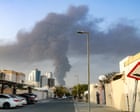
The US and Israel gravely underestimated Iran’s response – here in the UAE, we are seeing the consequences | Aniseh Bassiri Tabrizi
📖 Full Retelling
<p>My family is in Tehran; I am in Abu Dhabi. Across the region, ordinary people are paying the price for these attacks</p><p>Since Saturday, my mind has been torn between the place I live, Abu Dhabi, and Tehran, which has been the focus of my work and research for more than 15 years, and where I still have family. When I saw that Israel and the US had attacked Iran, I started worrying for family, thinking about potential consequences. But I barely had time to consider that bef
Entity Intersection Graph
No entity connections available yet for this article.
Original Source
The US and Israel gravely underestimated Iran’s response – here in the UAE, we are seeing the consequences Aniseh Bassiri Tabrizi My family is in Tehran; I am in Abu Dhabi. Across the region, ordinary people are paying the price for these attacks S ince Saturday, my mind has been torn between the place I live, Abu Dhabi, and Tehran, which has been the focus of my work and research for more than 15 years, and where I still have family. When I saw that Israel and the US had attacked Iran, I started worrying for family, thinking about potential consequences. But I barely had time to consider that before Donald Trump announced that this was about regime change. At that moment, I knew this was going to be big – worse than last June – and that it would lead into a regional schism. Predictably, Iran’s response started shortly after: first against Israel, then against states across the Gulf region, including the United Arab Emirates. It all followed the worst-case escalation scenarios we had been outlining since June, and especially since January, when – in the midst of protests – Donald Trump said “help” was on its way. I kept on trying to reach family when the internet there was working, which is, at best, for a few minutes a day. Each conversation is short, practical: are you OK? Is your area affected? My main worry is for those in Tehran, the city targeted most so far. Relatives describe being asked to continue going to work as the authorities try to project a sense of “business as usual”, even though the reality is far from normal. Communication is patchy, there are no sirens or alerts before an attack, news arrives in fragments – and ordinary people navigate risks they did not choose, absorbing the consequences of external events. There is fatigue in their voices – not panic. And at times, they write to check on me, on us. Which is even more surreal. In the UAE, the approach has been reassuringly methodical. Schools moved online . Workplaces shifted to remote arrangem...
Read full article at source