
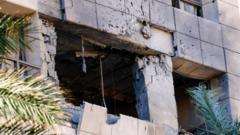
War expands to central Beirut as Israeli strike kills Iranians in luxury hotel
#Israeli strike #Beirut #Iranians killed #luxury hotel #war expansion #regional conflict #airstrike #Lebanon
📌 Key Takeaways
- Israeli airstrike targets a luxury hotel in central Beirut, marking a significant expansion of the conflict.
- The strike resulted in the deaths of Iranian individuals, escalating regional tensions.
- The attack signifies a direct Israeli military action within a densely populated area of Lebanon's capital.
- The incident raises immediate concerns about further retaliation and a broader regional war.
📖 Full Retelling
🏷️ Themes
Military Conflict, Regional Tensions
📚 Related People & Topics

Beirut
Capital and largest city of Lebanon
Beirut ( bay-ROOT; Arabic: بيروت, romanised: ) is the capital and largest city of Lebanon. As of 2025 Greater Beirut has a population of 2.4 million, just under half of Lebanon's population, which makes it the twelfth-largest city in the Levant region and the sixteenth-largest in the Arab world. Th...

Lebanon
Country in West Asia
Lebanon, officially the Lebanese Republic, is a country in the Levant region of West Asia. Situated at the crossroads of the Mediterranean Basin and the Arabian Peninsula, it is bordered by Syria to the north and east, Israel to the south, and the Mediterranean Sea to the west; Cyprus lies a short d...
Entity Intersection Graph
Connections for Beirut:
View full profileMentioned Entities
Deep Analysis
Why It Matters
This incident represents a significant escalation in regional conflict, directly targeting Iranian officials in a civilian area of Lebanon's capital. It threatens to expand the Israel-Hamas war into a broader regional confrontation involving Hezbollah and Iran more directly. The attack affects Lebanese civilians, regional stability, and international diplomatic efforts to contain the conflict. It also raises concerns about violations of sovereignty and potential retaliation cycles that could draw multiple actors into open warfare.
Context & Background
- Israel and Hezbollah have engaged in cross-border skirmishes since October 2023, following Hamas's attack on Israel
- Beirut has been largely spared direct strikes during recent tensions, with most fighting concentrated in southern Lebanon
- Iran maintains significant influence over Hezbollah and provides military support to the group
- Previous Israeli strikes in Lebanon have typically targeted Hezbollah infrastructure in southern areas or suburbs, not central Beirut hotels
- The luxury hotel district represents a civilian area and diplomatic hub in Lebanon's capital
What Happens Next
Hezbollah is likely to announce retaliatory measures within days, potentially involving rocket attacks on northern Israel or targeting Israeli interests abroad. Iran may respond through proxy forces in Syria or Iraq, or consider direct military action. The UN Security Council will likely convene emergency sessions, with Lebanon filing formal complaints about sovereignty violations. Regional tensions will spike further, potentially disrupting diplomatic efforts to negotiate Gaza ceasefire extensions.
Frequently Asked Questions
Israel likely identified the location as housing Iranian military advisors or intelligence operatives involved in coordinating with Hezbollah. Striking in central Beirut represents an escalation meant to demonstrate capability and deter Iranian involvement, though it risks major retaliation.
Lebanese civilians face increased danger as conflict spreads to populated urban centers. The strike undermines Lebanon's sovereignty and could lead to further economic disruption in a country already facing severe financial crisis and political instability.
Hezbollah will almost certainly retaliate, potentially with escalated rocket attacks on northern Israel or targeting Israeli assets abroad. The group's response will aim to demonstrate capability while calculating how far to escalate without triggering full-scale war.
This complicates US efforts to prevent regional war expansion, as it represents direct Israeli action against Iranian personnel. The US may pressure Israel to show restraint while working to prevent Iranian retaliation that could spiral into broader conflict.
While both sides have historically avoided direct confrontation, this strike increases that risk significantly. Iran may respond through proxies rather than directly, but the threshold for direct engagement has now been lowered, making miscalculation more dangerous.