
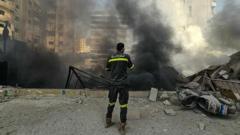
'We couldn't sleep because of fear': Residents flee as Israel pounds south Beirut
#Israel #Hezbollah #Lebanon #Beirut #Evacuation #Military Action #Displacement #Conflict
📌 Key Takeaways
- Israel conducts military operations against Hezbollah in Lebanon
- Thousands of Lebanese residents forced to flee homes
- Evacuation orders cover large areas including south Beirut
- Civilians report fear and panic due to displacement
- UN expresses concern over humanitarian impact
📖 Full Retelling
🏷️ Themes
Military Conflict, Civilian Displacement, Regional Tensions
📚 Related People & Topics
Hezbollah
Islamist movement and militant group based in Lebanon
Hezbollah is a Shia Islamist Lebanese political party and paramilitary group. Hezbollah's paramilitary wing is the Jihad Council, and its political wing is the Loyalty to the Resistance Bloc party in the Lebanese Parliament. Its armed strength was assessed to be equivalent to that of a medium-sized ...

Beirut
Capital and largest city of Lebanon
Beirut ( bay-ROOT; Arabic: بيروت, romanised: ) is the capital and largest city of Lebanon. As of 2025 Greater Beirut has a population of 2.4 million, just under half of Lebanon's population, which makes it the twelfth-largest city in the Levant region and the sixteenth-largest in the Arab world. Th...

Lebanon
Country in West Asia
Lebanon, officially the Lebanese Republic, is a country in the Levant region of West Asia. Situated at the crossroads of the Mediterranean Basin and the Arabian Peninsula, it is bordered by Syria to the north and east, Israel to the south, and the Mediterranean Sea to the west; Cyprus lies a short d...

Israel
Country in West Asia
Israel, officially the State of Israel, is a country in the Southern Levant region of West Asia. It is bordered by Lebanon to the north, Syria to the northeast, Jordan to the east, and Egypt to the southwest. Israel occupies the West Bank and the Gaza Strip of the Palestinian territories, as well as...
Entity Intersection Graph
Connections for Hezbollah:
View full profileMentioned Entities
Deep Analysis
Why It Matters
This news represents a significant escalation in the Israeli-Hezbollah conflict that could potentially trigger a wider regional war. The forced displacement of thousands of civilians creates an immediate humanitarian crisis with long-term implications for Lebanon and the region. The conflict affects not only residents of Lebanon and Israel but also has broader implications for Middle East stability, given Iran's backing of Hezbollah and existing regional tensions.
Context & Background
- Hezbollah emerged in the 1980s as an Iran-backed Shia militant group and political party in Lebanon
- The 2006 Lebanon War between Israel and Hezbollah resulted in approximately 1,200 Lebanese deaths and 165 Israeli deaths
- Hezbollah and Israel have engaged in periodic cross-border skirmishes since the 2006 war
- The Syrian civil war (2011-2018) saw Hezbollah fighting alongside Syrian government forces, increasing its military capabilities
- Tensions have escalated since the October 2023 Hamas attack on Israel and subsequent Israeli military operations in Gaza
- The UN has maintained peacekeeping forces (UNIFIL) in southern Lebanon since 1978 to monitor the border
What Happens Next
Israeli military operations in south Beirut and other areas of Lebanon are likely to continue in the short term. The UN and international organizations may attempt to establish humanitarian corridors for civilians, though access may be challenging. Increased diplomatic pressure on both Israel and Hezbollah to de-escalate is expected, though may be ineffective given current tensions. If the conflict intensifies, we may see more regional actors becoming involved, potentially leading to a wider conflict that could draw in Iran and other Middle Eastern powers.
Frequently Asked Questions
Hezbollah is an Iran-backed Shia militant group and political party in Lebanon that emerged in the 1980s. It has both military and political wings and has been engaged in conflicts with Israel since its formation.
Israel is targeting Hezbollah positions in response to cross-border attacks by the militant group. The Israeli Defense Forces have intensified their campaign against Hezbollah, which they consider a significant security threat to Israeli territory.
The conflict has forced thousands of Lebanese residents to flee their homes, creating a displacement crisis. Civilians have reported scenes of panic and confusion, with many expressing fear about their futures. The UN has expressed concern over civilian casualties and infrastructure damage.
The escalation of the Israeli-Hezbollah conflict could potentially lead to a wider regional war, given the involvement of Iran-backed Hezbollah and existing tensions in the Middle East. This could draw in other regional actors and further destabilize an already volatile region.
The conflict has deep roots in Israeli-Lebanese tensions dating back to the 1980s, including the 1982 Israeli invasion of Lebanon. The 2006 Lebanon War was a major escalation, and since then, both sides have engaged in periodic cross-border skirmishes.