
Black Hole Mergers Test the Limits of General Relativity
#black hole mergers #general relativity #gravitational waves #LIGO #Virgo #Einstein #astrophysics
📌 Key Takeaways
- Black hole mergers provide extreme conditions for testing Einstein's theory of general relativity.
- Observations from gravitational wave detectors like LIGO and Virgo are key to these tests.
- Researchers are looking for deviations from general relativity predictions in merger signals.
- Findings could reveal new physics or confirm the theory's robustness in strong gravity.
📖 Full Retelling
🏷️ Themes
Astrophysics, General Relativity, Gravitational Waves
📚 Related People & Topics

Albert Einstein
German-born theoretical physicist (1879–1955)
Albert Einstein (14 March 1879 – 18 April 1955) was a German-born theoretical physicist best known for developing the theory of relativity. Einstein also made important contributions to quantum theory. His mass–energy equivalence formula E = mc2, which arises from special relativity, has been called...
General relativity
Theory of gravitation as curved spacetime
General relativity, also known as the general theory of relativity, and as Einstein's theory of gravity, is the geometric theory of gravitation published by Albert Einstein in May 1916 and is the accepted description of the gravitation of macroscopic objects in modern physics. General relativity gen...

LIGO
Gravitational wave observatory site
The Laser Interferometer Gravitational-Wave Observatory (LIGO) is a large-scale physics experiment and observatory designed to detect cosmic gravitational waves. Prior to LIGO, all data about the universe has come in the form of light and other forms of electromagnetic radiation, from limited direct...
Entity Intersection Graph
Connections for Albert Einstein:
View full profileMentioned Entities
Deep Analysis
Why It Matters
This research matters because it pushes the boundaries of our understanding of fundamental physics by testing Einstein's theory of general relativity under extreme conditions. It affects astrophysicists, cosmologists, and theoretical physicists who study gravity and the universe's structure. The findings could reveal new physics beyond our current models, potentially leading to breakthroughs in our comprehension of space-time, quantum gravity, and the nature of black holes themselves.
Context & Background
- Einstein's general relativity, published in 1915, describes gravity as the curvature of spacetime caused by mass and energy
- Black holes are regions where gravity is so strong that nothing, not even light, can escape, making them ideal laboratories for testing extreme gravity
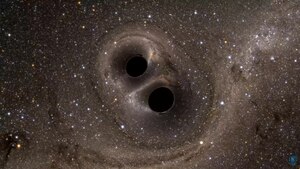
- The first direct detection of gravitational waves from black hole mergers by LIGO in 2015 confirmed a key prediction of general relativity
- General relativity has passed all tests so far but is known to be incompatible with quantum mechanics at very small scales
- Previous tests of general relativity have been conducted in weaker gravitational fields, such as in our solar system
What Happens Next
Researchers will continue analyzing data from current and future gravitational wave observatories like LIGO, Virgo, and KAGRA. The planned LISA space-based gravitational wave detector (scheduled for launch in the 2030s) will provide even more precise measurements of black hole mergers. Scientists will develop more sophisticated models to compare with observations, potentially leading to either stronger confirmation of general relativity or discovery of deviations that require new theoretical frameworks.
Frequently Asked Questions
Black hole mergers create the strongest gravitational fields in the universe, where general relativity's predictions should be most apparent. The violent collisions produce gravitational waves that carry information about how gravity behaves in these extreme conditions, allowing precise measurements impossible in weaker gravitational fields.
If general relativity fails these extreme tests, it would indicate that Einstein's theory is incomplete and needs modification or replacement. This could open the door to new theories of gravity that might reconcile general relativity with quantum mechanics, potentially leading to a unified theory of fundamental physics.
Scientists primarily detect black hole mergers through gravitational wave observatories like LIGO and Virgo, which measure tiny ripples in spacetime caused by these collisions. They also study electromagnetic signals when black holes merge with other objects like neutron stars, and use computer simulations to model the mergers for comparison with observations.
While testing general relativity is primarily fundamental science, the technologies developed for gravitational wave detection have applications in precision measurement and sensing. Understanding black hole mergers also helps us comprehend the evolution of galaxies and the universe's structure, with potential long-term implications for our understanding of cosmic history.