
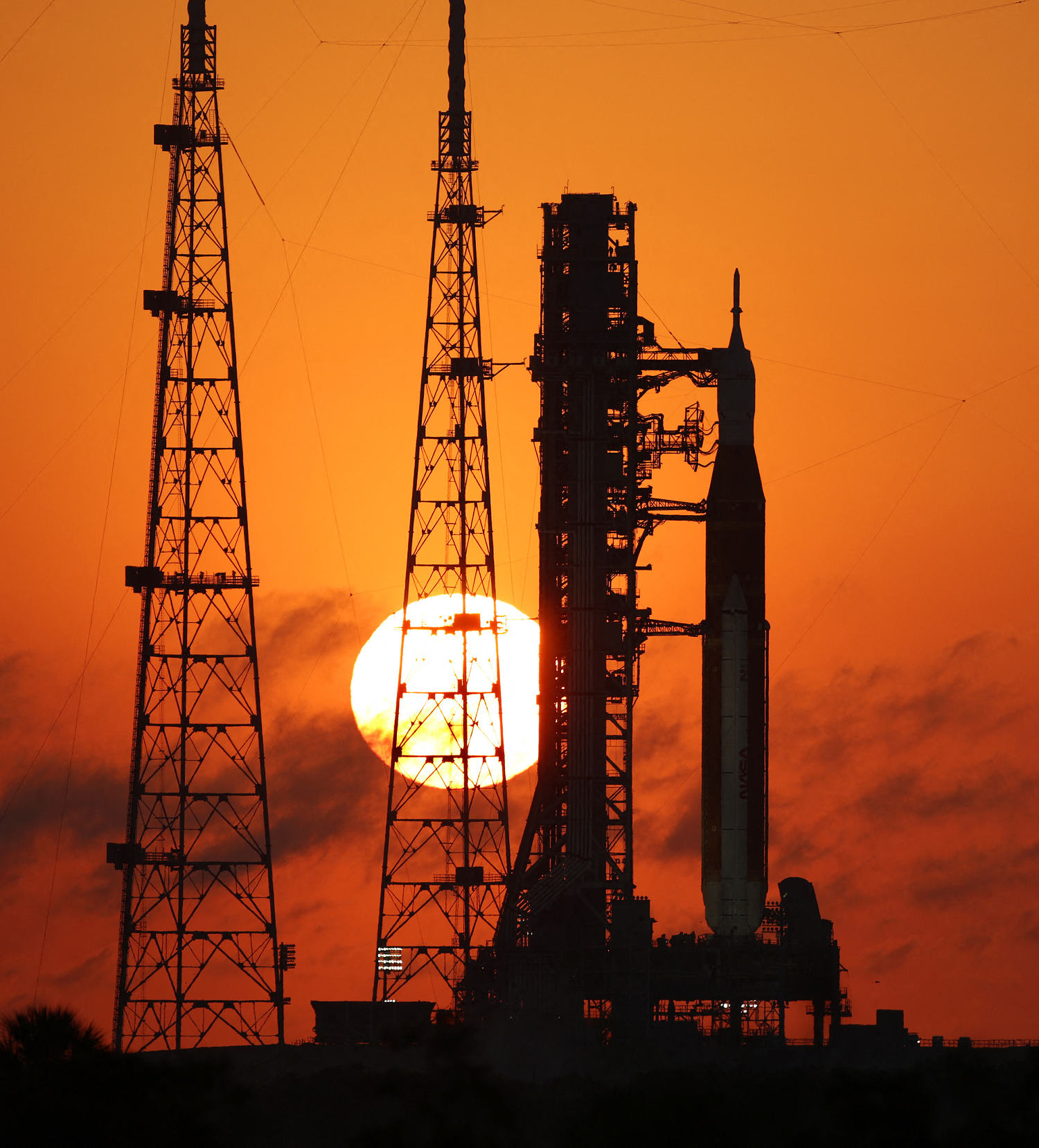
NASA's long, fraught, over-budget path back to the moon
📖 Full Retelling
📚 Related People & Topics

NASA
American space and aeronautics agency
The National Aeronautics and Space Administration (NASA ) is an independent agency of the U.S. federal government responsible for the United States' civil space program and for research in aeronautics and space exploration. Headquartered in Washington, D.C., NASA operates ten field centers across th...

Orion (spacecraft)
American crewed spacecraft for the Artemis program
Orion (Orion Multi-Purpose Crew Vehicle or Orion MPCV) is a partially reusable crewed spacecraft used in NASA's Artemis program. The spacecraft consists of a Crew Module (CM) space capsule designed by Lockheed Martin that is paired with a European Service Module (ESM) manufactured by Airbus Defence ...

Artemis program
NASA-led lunar exploration program
The Artemis program is a Moon exploration program led by the United States' National Aeronautics and Space Administration (NASA), formally established in 2017 through Space Policy Directive-1. The program intends to reestablish a human presence on the Moon for the first time since the Apollo 17 miss...

Space Launch System
NASA super heavy-lift expendable launch vehicle
The Space Launch System (SLS) is an American super heavy-lift expendable launch vehicle used by NASA. As the primary launch vehicle of the Artemis Moon landing program, SLS is designed to launch the crewed Orion spacecraft on a trans-lunar trajectory. SLS first launched on 16 November 2022 for the u...
Entity Intersection Graph
Connections for NASA:
Mentioned Entities
Deep Analysis
Why It Matters
This news matters because NASA's Artemis program represents humanity's first return to the moon in over 50 years, with ambitions for sustainable lunar presence and eventual Mars missions. The program's budget overruns and delays affect American taxpayers and international partners who have invested billions, while technical challenges impact aerospace contractors and scientific communities awaiting lunar research opportunities. Success or failure will influence global space leadership perceptions and determine whether NASA can establish a viable model for deep space exploration beyond low Earth orbit.
Context & Background
- NASA's last human moon landing was Apollo 17 in 1972, ending the Apollo program that began in 1961
- The Space Launch System (SLS) rocket development began in 2011 with initial plans for a 2017 launch, now delayed to 2025+
- Artemis program costs have exceeded $40 billion, with SLS alone costing over $20 billion through development
- International partnerships include ESA, JAXA, and CSA contributing modules for the Lunar Gateway station
- Commercial partners like SpaceX with Starship and Blue Origin with Blue Moon are developing lunar landers under NASA contracts
What Happens Next
NASA plans Artemis II's crewed lunar flyby in September 2025, followed by Artemis III's lunar landing no earlier than 2026. Critical upcoming milestones include Starship's orbital refueling tests, SLS Block 1B development, and Lunar Gateway component launches beginning 2025. Congressional budget decisions in late 2024 will determine funding for sustained lunar operations through the 2030s.
Frequently Asked Questions
Artemis faces different political and technical realities—it requires sustainable infrastructure rather than flags-and-footprints missions, uses more complex commercial partnerships, and operates under tighter budget scrutiny without Cold War urgency.
Overruns stem from SLS's reuse of Space Shuttle components requiring extensive redesign, pandemic-related supply chain issues, and evolving mission requirements that increased system complexity beyond initial estimates.
Artemis focuses on lunar South Pole exploration for water ice resources, aims for extended surface stays up to weeks, and will deploy advanced instruments for sustained lunar science impossible during Apollo's brief visits.
NASA would likely delay the landing mission or consider alternative lander options, though this would require renegotiating contracts and potentially adding years to the timeline given Starship's integral role.
China's planned 2030s lunar base creates geopolitical competition, increasing political pressure on Artemis's timeline while potentially limiting international cooperation due to US-China space collaboration restrictions.