
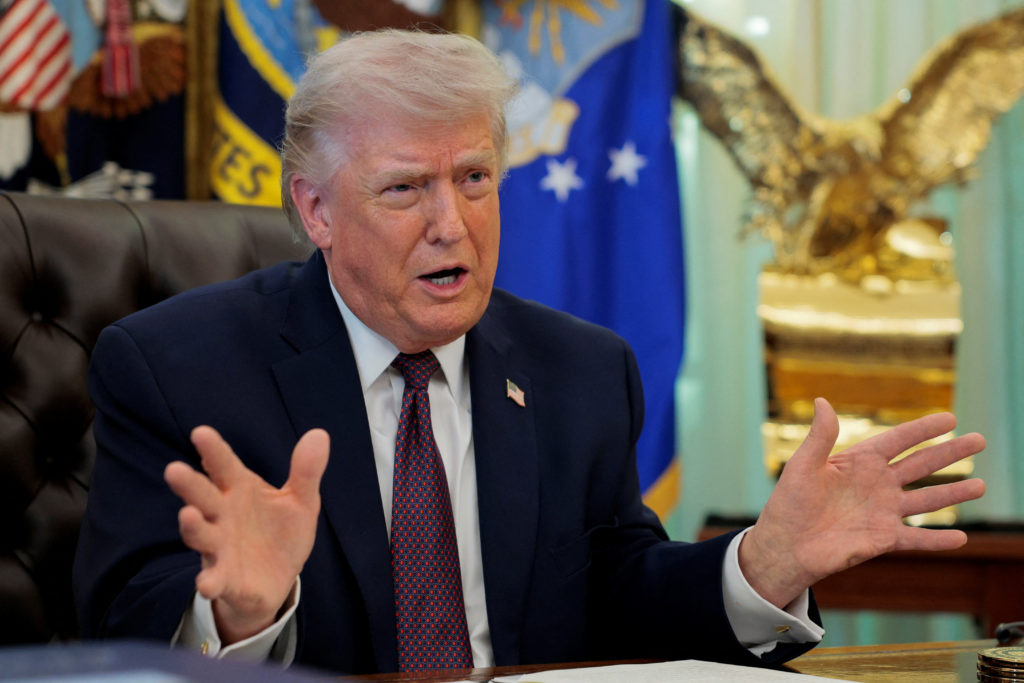
Trump signs order aimed at stabilizing college sports with threats to federal funding
#Trump #executive order #college sports #federal funding #NIL rights #athlete compensation #amateurism
📌 Key Takeaways
- President Trump signed an executive order targeting college sports stability.
- The order uses threats to federal funding as leverage for compliance.
- It aims to enforce standards for athlete compensation and name, image, and likeness (NIL) rights.
- The move addresses ongoing debates over amateurism and financial fairness in collegiate athletics.
📖 Full Retelling
🏷️ Themes
College Sports, Federal Policy
📚 Related People & Topics

Donald Trump
President of the United States (2017–2021; since 2025)
Donald John Trump (born June 14, 1946) is an American politician, media personality, and businessman who is the 47th president of the United States. A member of the Republican Party, he served as the 45th president from 2017 to 2021. Born into a wealthy New York City family, Trump graduated from the...
Entity Intersection Graph
Connections for Donald Trump:
Mentioned Entities
Deep Analysis
Why It Matters
This executive order matters because it directly impacts the multi-billion dollar college sports industry and the hundreds of thousands of student-athletes who participate in NCAA programs. It affects universities that rely on federal funding for research and operations, potentially forcing them to comply with new regulations or face financial consequences. The order could reshape the relationship between athletes, educational institutions, and the NCAA by introducing federal oversight into what has traditionally been governed by private athletic associations.
Context & Background
- The NCAA has faced increasing legal challenges regarding athlete compensation, most notably the O'Bannon v. NCAA case (2014) which challenged NCAA rules prohibiting athlete compensation
- College sports generate approximately $15 billion annually in revenue, with major conferences like the SEC and Big Ten distributing hundreds of millions to member schools
- The debate over 'name, image, and likeness' (NIL) rights for college athletes has intensified in recent years, with several states passing laws allowing athletes to profit from endorsements
- The NCAA has historically operated as a self-governing body with limited federal oversight, despite receiving substantial indirect federal funding through university grants and student financial aid
What Happens Next
The NCAA and member institutions will need to review their policies to ensure compliance with the executive order's requirements. Congressional hearings on college sports reform are likely to follow, potentially leading to legislative action. State legislatures may accelerate their own NIL legislation to align with federal expectations. Legal challenges to the order's constitutionality could emerge from the NCAA or affected universities.
Frequently Asked Questions
The order threatens to withhold federal funding from colleges and universities that don't adopt policies protecting student-athletes' rights and ensuring fair treatment. It pushes institutions to establish clearer rules around athlete compensation and transfers while maintaining educational standards.
Smaller colleges face disproportionate risk since they often rely more heavily on federal funding for operations. They may struggle to implement costly compliance measures while maintaining competitive athletic programs, potentially widening the gap between resource-rich and resource-poor institutions.
Not necessarily - the order focuses on name, image, and likeness rights rather than salary payments. It creates pressure for standardized NIL rules but doesn't mandate traditional employment relationships between athletes and institutions.
Legal experts may challenge whether the federal government can condition education funding on athletic program policies, potentially arguing this exceeds executive authority or violates principles of federalism in education regulation.
The uncertainty created by federal intervention could complicate media rights negotiations, as networks may seek protections against potential disruptions to college sports structures and athlete eligibility rules.