
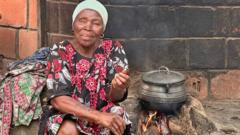
'We want a voice in our land' - the people evicted to build Nigeria's capital
📖 Full Retelling
People evicted to build Nigeria's capital accuse the government of failing to fulfill its promises to them.
Entity Intersection Graph
No entity connections available yet for this article.
Original Source
'We want a voice in our land' - the people evicted to build Nigeria's capital 12 minutes ago Share Save Add as preferred on Google Now in her 80s, Lami Ezekiel remembers construction crews arriving in her ancestral home in Maitama, as it was destroyed to build Nigeria's capital, Abuja. "We just saw big trucks and construction vehicles destroying our farms," she recalls. This was in the late 1980s. She, like others who lived on the land on which the city was built, say they are still waiting for the compensation they were promised at the time. The planning for the new capital right in the centre of the country began a decade earlier. On 4 February 1976, the military government led by Murtala Muhammed created an area called the Federal Capital Territory - 7,315 sq km (2,824 sq miles) of land carved from Niger, Plateau and Kaduna states. Born in 1982 in Kabusa, which lies within the FCT, Isaac David remembers a childhood of streams and farmland where families drank water from springs and cultivated land that had sustained them for generations. Today, where streams once flowed, stands a luxury hotel - the Transcorp Hilton Abuja. Land once planted with crops now holds buildings such as the United Nations headquarters and the embassy of the United States. Nigeria's seat of power, the Aso Rock presidential villa, rests on what was once a community shrine. "Those of us who want to farm now have to go and buy farmland on the outskirts of town," says David, who now owns farms in neighbouring Niger state. Lagos, the former capital, was seen as vulnerable because of its coastal location and politically sensitive because it lay in the heart of Yoruba land in a country managing ethnic rivalries. Abuja was presented as neutral territory - officially described as "no man's land". But for at least 10 indigenous groups, including the Gbagyi, whose homes and farms were replaced by ministries and mansions, that description still stings. Daniel Aliyu Kwali, president of the FCT Stakehol...
Read full article at source