
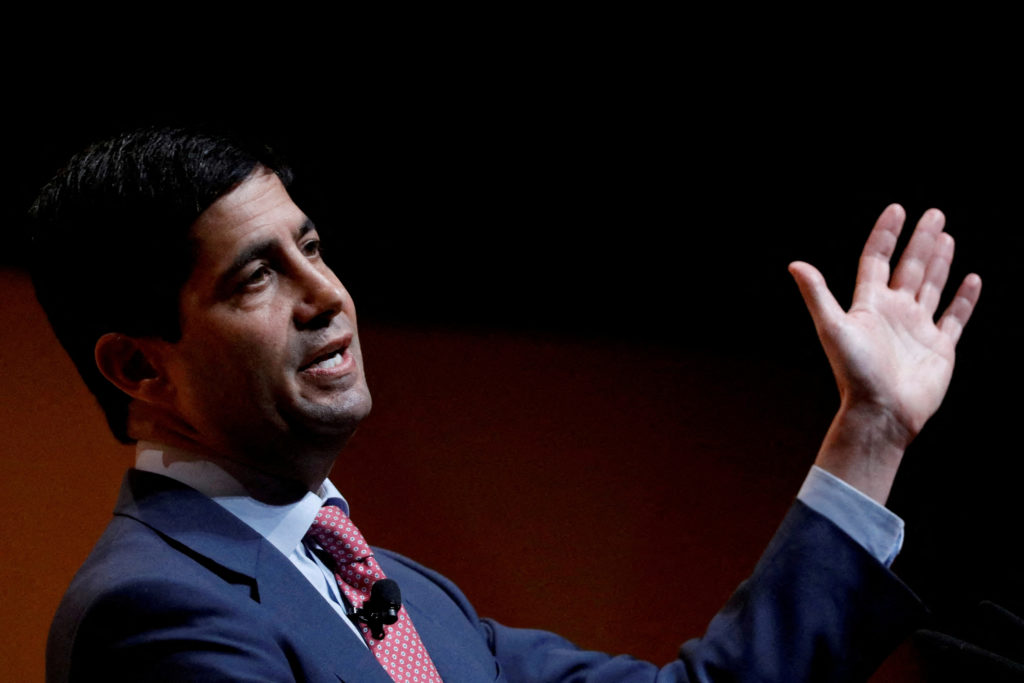
White House formally nominates Kevin Warsh to be next Federal Reserve chair
#Federal Reserve #Kevin Warsh #Jerome Powell #US Politics #Senate Banking Committee #Donald Trump #Interest Rates #Inflation
📌 Key Takeaways
- Trump administration formally nominates Kevin Warsh to succeed Jerome Powell as Fed chair.
- Nomination faces Senate Banking Committee opposition from Sen. Thom Tillis.
- Opposition tied to Justice Department investigation into Powell's testimony.
- Warsh supports lower interest rates and cites AI as a tool to curb inflation.
- Powell's term ends in two months, creating a leadership vacuum.
📖 Full Retelling
🏷️ Themes
Federal Reserve, US Politics, Economic Policy, Banking Committee
📚 Related People & Topics

Kevin Warsh
American financier (born 1970)
Kevin Maxwell Warsh (born April 13, 1970) is an American financier and bank executive. He served as a member of the Federal Reserve Board of Governors from 2006 to 2011. During and in the aftermath of the 2008 financial crisis, Warsh acted as the central bank's primary liaison to Wall Street, and s...

United States Senate Committee on Banking, Housing, and Urban Affairs
Standing committee of the United States Senate
The United States Senate Committee on Banking, Housing, and Urban Affairs (formerly the Committee on Banking and Currency), also known as the Senate Banking Committee, has jurisdiction over matters related to banks and banking, price controls, deposit insurance, export promotion and controls, federa...

Jerome Powell
American central banker (born 1953)
Jerome Hayden "Jay" Powell (born February 4, 1953) is an American central banker who has been the 16th chair of the Federal Reserve since 2018. He was previously both a lawyer and investment banker in the private sector before entering public service. A native of Washington, D.C., Powell graduated...

Federal Reserve
Central banking system of the US
The Federal Reserve System (often shortened to the Federal Reserve, or simply the Fed) is the central banking system of the United States. It was created on December 23, 1913, with the enactment of the Federal Reserve Act, after a series of financial panics (particularly the panic of 1907) led to th...

Politics of the United States
In the United States, politics functions within a framework of a constitutional federal republic with a presidential system. The three distinct branches share powers: Congress, which forms the legislative branch, a bicameral legislative body comprising the House of Representatives and the Senate; th...
Entity Intersection Graph
Connections for Kevin Warsh:
Mentioned Entities
Deep Analysis
Why It Matters
The White House’s nomination of Kevin Warsh as the next Federal Reserve chair marks a significant shift in economic policy direction under the Trump administration, signaling potential changes in monetary strategy amid ongoing political and procedural challenges. This decision could reshape inflation control efforts, interest rate policies, and Fed accountability given the backdrop of recent controversies involving Jerome Powell." "context_background": [ "Warsh’s past criticism of low-interest-rate policies during the pandemic aligns with Trump’s economic agenda but contrasts with current Fed officials’ views on AI-driven productivity gains and inflation risks.", "The Senate Banking Committee’s opposition hinges on unresolved criminal investigations into Powell, delaying confirmation until procedural and legal matters are resolved.", "Warsh’s shift in stance—supporting rate cuts to combat inflation—contrasts with his earlier hawkish critiques of the Fed’s monetary approach, raising questions about policy consistency.", "The nomination underscores broader political tensions between executive branch economic priorities and congressional scrutiny over central banking independence", "AI-driven productivity debates divide economists: Warsh argues it will enable rate cuts without inflationary pressures, while most Fed members remain skeptical" ], "what_happens_next": "Warsh’s nomination faces an uncertain path through the Senate Banking Committee, where Republican Sen. Thom Tillis has vowed to oppose confirmation until Powell’s investigation concludes. If Democrats block Warsh alongside Republicans, his confirmation could stall indefinitely, delaying a Fed chair transition that Powell is set to vacate in two months. The committee may hold hearings but likely fail to reach a consensus, prolonging uncertainty over economic policy direction." "faq": [ { "question": "What are the key political and procedural hurdles for Warsh’s confirmation?
Context & Background
- Warsh’s past criticism of low-interest-rate policies during the pandemic aligns with Trump’s economic agenda but contrasts with current Fed officials’ views on AI-driven productivity gains and inflation risks.
- The Senate Banking Committee’s opposition hinges on unresolved criminal investigations into Powell, delaying confirmation until procedural and legal matters are resolved.
- Warsh’s shift in stance—supporting rate cuts to combat inflation—contrasts with his earlier hawkish critiques of the Fed’s monetary approach, raising questions about policy consistency.
- The nomination underscores broader political tensions between executive branch economic priorities and congressional scrutiny over central banking independence
- AI-driven productivity debates divide economists: Warsh argues it will enable rate cuts without inflationary pressures, while most Fed members remain skeptical
What Happens Next
Warsh’s nomination faces an uncertain path through the Senate Banking Committee, where Republican Sen. Thom Tillis has vowed to oppose confirmation until Powell’s investigation concludes. If Democrats block Warsh alongside Republicans, his confirmation could stall indefinitely, delaying a Fed chair transition that Powell is set to vacate in two months. The committee may hold hearings but likely fail to reach a consensus, prolonging uncertainty over economic policy direction." "faq": [ { "question": "What are the key political and procedural hurdles for Warsh’s confirmation?