IEEPA does not authorize presidential tariff authority
Decision included both conservative and liberal justices
Different reasoning approaches were used by majority justices
Decision may constrain future presidential tariff actions
📖 Full Retelling
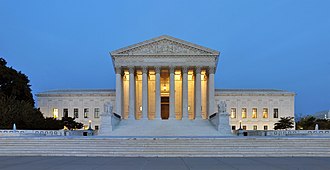
The Supreme Court in Washington on February 20, 2026, struck down President Trump's sweeping tariffs in a 6-3 decision, ruling that the International Emergency Economic Powers Act does not authorize the president to impose such levies, which Trump had invoked to address trade deficits and drug trafficking concerns. The majority opinion, authored by Chief Justice John Roberts and joined by three liberal and three conservative justices, found that IEEPA's authority to 'regulate importation' does not include the power to impose tariffs, which operate differently by raising revenue for the Treasury. Trump had used the 1977 law for his tariffs on nearly every country and for specific levies against China, Canada and Mexico over fentanyl concerns, marking the first time any president had used IEEPA for tariffs. The decision highlighted that the law contains no mention of tariffs, duties, or similar terms, and that Congress has historically delegated tariff authority through explicit terms with strict constraints rather than vague language.
The opinion revealed interesting divisions among the majority justices, with conservatives Roberts, Gorsuch and Barrett applying the 'major questions doctrine' requiring clear congressional authorization for significant economic actions, while liberals Sotomayor, Kagan and Jackson reached the same conclusion through standard statutory interpretation. Roberts emphasized the extraordinary economic consequences of the tariffs, noting they could reduce the national deficit by $4 trillion and international agreements could be worth $15 trillion. In contrast, Kavanaugh's dissent argued that the president's authority to 'regulate importation' encompasses tariffs as a traditional tool for controlling commerce, and that the major questions doctrine should not apply to foreign affairs where courts typically defer to presidential authority.
The ruling represents a significant limitation on presidential tariff authority under IEEPA, though presidents may still use other statutory justifications for such measures. The decision underscores the judiciary's role in interpreting the boundaries of executive power, particularly when presidents assert expansive authority during national emergencies. The unusual alliance of three liberal and three conservative justices suggests broad agreement on limiting presidential tariff power despite different philosophical approaches to statutory interpretation and the major questions doctrine.
🏷️ Themes
Presidential authority limits, Congressional power delegation, Trade policy constraints
In most legal jurisdictions, a supreme court, also known as a court of last resort, apex court, high (or final) court of appeal, and court of final appeal, is the highest court within the hierarchy of courts. Broadly speaking, the decisions of a supreme court are binding on all other courts in a nat...
A commercial policy (also referred to as a trade policy or international trade policy) is a government's policy governing international trade. Commercial policy is an all encompassing term that is used to cover topics which involve international trade. Trade policy is often described in terms of a ...
The International Emergency Economic Powers Act (IEEPA), Title II of Pub. L. 95–223, 91 Stat. 1626, enacted December 28, 1977, is a United States federal law authorizing the president to regulate international commerce after declaring a national emergency in response to any unusual and extraordinary...
Politics Why the Supreme Court struck down Trump's most sweeping tariffs By Melissa Quinn Melissa Quinn Senior Reporter, Politics Melissa Quinn is a senior reporter for CBSNews.com, where she covers U.S. politics, with a focus on the Supreme Court and federal courts. Read Full Bio Melissa Quinn February 20, 2026 / 2:26 PM EST / CBS News Add CBS News on Google Washington — The Supreme Court on Friday invalidated President Trump's most sweeping tariffs , finding in a 6-3 ruling that he does not have the authority to impose the levies using an emergency powers law. The 6-3 decision included three liberals and three conservatives in the majority. The coalition included Chief Justice John Roberts and Justices Sonia Sotomayor, Elena Kagan, Neil Gorsuch, Amy Coney Barrett and Ketanji Brown Jackson. Justices Clarence Thomas, Samuel Alito and Brett Kavanaugh dissented. The six justices found that the law known as the International Emergency Economic Powers Act, or IEEPA, does not give the president the power to impose tariffs. Enacted in 1977, IEEPA authorizes the president to "regulate … importation" to deal with "any unusual and extraordinary threat" to national security, foreign policy or the U.S. economy. When he announced his most sweeping tariffs on nearly every country last April, Mr. Trump invoked IEEPA to respond to what he said were "large and persistent" trade deficits. He also relied on the law to hit China, Canada and Mexico with levies over what the president claimed was their failure to stem the flow of illicit fentanyl and other drugs into the U.S. No president before Mr. Trump had used IEEPA to impose tariffs, and the law does not use that word or others like it, such as duty, levy or tax. All six of the justices who were in the majority agreed that IEEPA does not give the president the power to impose levies. "Our task today is to decide only whether the power to 'regulate … importation,' as granted to the president in IEEPA, embraces the power to impose ta...