

With tariffs ruling, Supreme Court reasserts its power to check Trump
#Supreme Court #Trump tariffs #IEEPA #John Roberts #Global trade #Presidential authority #Separation of powers #6-3 decision
📌 Key Takeaways
- Supreme Court struck down Trump's global tariffs in 6-3 decision
- Court reasserted its role as a check on presidential power
- Conservative justices Gorsuch and Barrett joined liberals against Trump
- Trump reacted angrily, calling justices 'fools' and 'lapdogs'
- Ruling marks shift from court's recent pattern of siding with Trump
📖 Full Retelling
🏷️ Themes
Judicial Review, Presidential Power, Trade Policy, Separation of Powers
📚 Related People & Topics
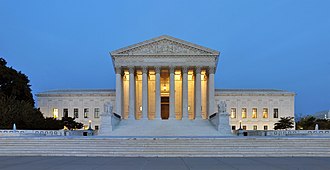
Supreme court
Highest court in a jurisdiction
In most legal jurisdictions, a supreme court, also known as a court of last resort, apex court, high (or final) court of appeal, and court of final appeal, is the highest court within the hierarchy of courts. Broadly speaking, the decisions of a supreme court are binding on all other courts in a nat...

International Emergency Economic Powers Act
United States federal law
The International Emergency Economic Powers Act (IEEPA), Title II of Pub. L. 95–223, 91 Stat. 1626, enacted December 28, 1977, is a United States federal law authorizing the president to regulate international commerce after declaring a national emergency in response to any unusual and extraordinary...

John Roberts
Chief Justice of the United States since 2005
John Glover Roberts Jr. (born January 27, 1955) is an American jurist who has served since 2005 as the 17th chief justice of the United States. Though primarily an institutionalist, he has been described as having a moderate conservative judicial philosophy.
International trade
Exchange across international borders
International trade is the exchange of capital, goods, and services across international borders or territories because there is a need or want of goods or services. In most countries, such trade represents a significant share of gross domestic product (GDP). While international trade has existed t...
Tariffs in the Trump administration
Topics referred to by the same term
Tariffs in the Trump administration could refer to:

Donald Trump
President of the United States (2017–2021; since 2025)
Donald John Trump (born June 14, 1946) is an American politician, media personality, and businessman who is the 47th president of the United States. A member of the Republican Party, he served as the 45th president from 2017 to 2021. Born into a wealthy New York City family, Trump graduated from the...
Entity Intersection Graph
Connections for Supreme court:
Mentioned Entities
Deep Analysis
Why It Matters
This ruling is a pivotal moment for the separation of powers, establishing that the judiciary will not defer to the executive branch even when the president claims emergency authority to reshape the economy. It directly impacts American businesses and consumers by immediately removing the financial burden of sweeping tariffs on nearly all U.S. trading partners. Furthermore, the decision signals a limit on the Trump administration's ability to govern through executive orders without congressional approval. The fracture among conservative justices, specifically Trump appointees voting against him, reinforces the independence of the federal judiciary. Ultimately, this sets a binding precedent that restricts the future use of the International Emergency Economic Powers Act for trade protectionism.
Context & Background
- The International Emergency Economic Powers Act (IEEPA) of 1977 was enacted to allow presidents to regulate commerce during national emergencies, specifically addressing foreign threats, but had never been used to impose broad tariffs.
- Prior to this February 2026 decision, the Supreme Court had frequently sided with the Trump administration on emergency requests, allowing rapid implementation of policies on immigration and federal employment.
- President Trump had attempted to use IEEPA to justify tariffs on nearly all U.S. trading partners by arguing that trade deficits posed a national security threat.
- Justices Neil Gorsuch and Amy Coney Barrett were both appointed by Trump but have occasionally diverged from his administration's legal theories in the past regarding executive authority.
- This case marked the first time during Trump's second term that the Supreme Court conducted a full merits review of a major administration policy rather than ruling on emergency procedural requests.
What Happens Next
The Trump administration is expected to attempt to rewrite the tariff orders to fit within the Court's interpretation of IEEPA or seek alternative statutory authority from Congress. Congressional leaders may face increased pressure to clarify trade delegation laws to prevent future executive overreach. Legal experts anticipate a wave of new challenges against other executive actions, citing this ruling as a precedent for limiting presidential power. The administration will likely escalate its rhetorical attacks on the judiciary to mobilize its political base ahead of the 2026 midterms.
Frequently Asked Questions
The Court ruled that President Trump exceeded his authority under the International Emergency Economic Powers Act (IEEPA) of 1977. They determined that this statute does not grant the president the power to impose broad tariffs on trading partners.
The ruling was a 6-3 decision, with Chief Justice John Roberts writing the majority opinion. He was joined by the court's three liberal justices and two conservative Trump appointees, Neil Gorsuch and Amy Coney Barrett.
President Trump responded with intense criticism, denouncing the majority justices as 'fools' and 'lapdogs' for Democrats. He also claimed the decision was unpatriotic and suggested the justices were influenced by foreign interests.
Unlike previous instances where the court deferred to the administration on emergency requests, this case involved a thorough examination of the policy's merits. It represents the first major check on executive power by the court during Trump's second term.
Their votes demonstrate that the court maintains its institutional independence and will not provide unlimited legal cover for a president who appointed them. It highlights a conservative judicial skepticism regarding the expansion of executive power.