
Who / What
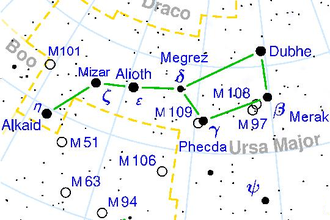
The Big Dipper is an asterism, a pattern of seven bright stars within the larger constellation Ursa Major. It is composed of six second-magnitude stars and one third-magnitude star, Megrez (δ), forming a distinct shape resembling a dipper or plough.
Background & History
The Big Dipper has been recognized as a distinct star grouping across numerous cultures for millennia. Its historical significance is rooted in its use for navigation and timekeeping, particularly as a pointer to locate Polaris, the North Star. Different cultures have attributed various mythological stories to its pattern, solidifying its place in human history long before modern astronomy.
Why Notable
Its notability stems from its prominence in the night sky and its practical utility. The asterism serves as a crucial navigational aid in the Northern Hemisphere, helping to determine direction. Furthermore, its distinctive and easily recognizable shape has made it one of the most famous celestial patterns, featuring prominently in folklore, literature, and popular culture worldwide.
In the News
The Big Dipper remains a subject of interest in amateur astronomy and educational outreach, frequently featured in stargazing events and planetarium shows. Its visibility and recognizability make it a key reference point for public observations of celestial events, such as meteor showers, keeping it relevant in contemporary sky-watching activities.

