
Who / What
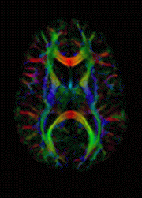
Diffusion-weighted magnetic resonance imaging (DWI or DW-MRI) is a method that uses specific MRI sequences and software to generate images based on the diffusion of water molecules within biological tissues. It allows for the mapping of how water molecules move within tissues, providing contrast in MR images. This technique reflects interactions with obstacles like macromolecules, fibers, and membranes.
Background & History
The development of DWI builds upon the fundamental principles of magnetic resonance imaging (MRI), which relies on the magnetic properties of atomic nuclei. DWI emerged as an advancement to visualize water diffusion within tissues, offering insights into tissue microstructure. It has been refined over several decades with advancements in gradient technology and image processing techniques enabling more detailed and quantitative analysis of water diffusion.
Why Notable
DWI is a significant tool in medical imaging due to its ability to detect subtle changes in water diffusion that may indicate pathological processes. It provides valuable information about tissue integrity, cellularity, and molecular changes often associated with diseases like stroke, tumors, and neurodegenerative disorders. The technique’s non-invasive nature makes it crucial for diagnostic purposes and monitoring treatment response.
In the News
DWI continues to be a vital tool in neurological diagnosis, particularly in the rapid assessment of stroke and other cerebrovascular events. Recent developments focus on improving quantitative analysis techniques to provide more precise measurements of diffusion, leading to better patient outcomes. Ongoing research explores its potential applications in other areas like oncology and neurodegeneration.
