
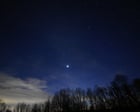
Six planets line up for rare parade throughout February
#Planetary alignment #Planet parade #NASA #Stargazing #Solar system #Celestial event #February 28
📌 Key Takeaways
- Six planets including Mercury, Venus, Jupiter, Saturn, Uranus, and Neptune will align in late February.
- The celestial event, known as a 'planet parade,' will reach its peak visibility on February 28.
- NASA defines a planetary alignment as a grouping of four or more planets in the same sky sector.
- While some planets will be visible to the naked eye, others like Neptune will require optical aids like telescopes.
📖 Full Retelling
Stargazers and space enthusiasts across the globe are preparing for a rare celestial event as six planets—Mercury, Venus, Jupiter, Saturn, Uranus, and Neptune—prepare to align across the night sky throughout February 2025. This atmospheric spectacle, often referred to as a "planetary parade," is expected to reach its peak visibility on February 28, offering a unique opportunity for observers to witness several members of our solar system appearing in a relatively straight line due to their orbital positions relative to Earth.
According to NASA, a planetary alignment occurs when at least four or five planets appear to cluster in the same region of the sky from a viewer's perspective on Earth. While these planets are actually millions of miles apart in space, their specific positions in their respective orbits occasionally create the illusion of a synchronized march across the heavens. For this February event, the combination of six planets makes it a significantly more rare occurrence than the more common three-planet groupings.
To view the event at its height on February 28, experts suggest finding a location with a clear, unobstructed horizon and minimal light pollution. While brighter planets like Venus and Jupiter are often visible to the naked eye under the right conditions, spotting the more distant or smaller planets such as Neptune and Uranus will likely require the use of binoculars or a telescope. Astronomers note that such alignments are not only visual treats but also serve as important reminders of the immense scale and predictable mechanics of the solar system.
🏷️ Themes
Astronomy, Science, Space Exploration
Entity Intersection Graph
No entity connections available yet for this article.