
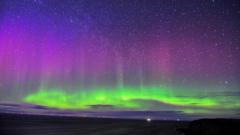
More sightings of the Northern Lights with stunning bright colours
#Northern Lights #Aurora Borealis #solar activity #geomagnetic storm #astronomy #natural phenomena #skywatching
📌 Key Takeaways
- Increased sightings of the Northern Lights reported globally.
- Auroras display unusually bright and vivid colors.
- Solar activity, such as geomagnetic storms, is driving the phenomenon.
- The event is visible at lower latitudes than typical.
📖 Full Retelling
🏷️ Themes
Astronomy, Natural Phenomena
📚 Related People & Topics
Northern Lights
Topics referred to by the same term
Northern lights most commonly refers to the aurora borealis, a natural light display in Earth's sky.

Aurora
Atmospheric effect caused by the solar wind
An aurora (pl. aurorae or auroras) is a natural light display in Earth's sky, predominantly observed in high-latitude regions around the Arctic and Antarctic. The terms northern lights (aurora borealis) and southern lights (aurora australis) are used in the Northern and Southern Hemispheres respecti...
Entity Intersection Graph
Connections for Northern Lights:
Mentioned Entities
Deep Analysis
Why It Matters
Increased Northern Lights sightings matter because they provide accessible natural beauty that boosts tourism in northern regions and offers educational opportunities about space weather. This phenomenon affects astronomers, photographers, and travelers who plan expeditions to witness the auroras. The heightened activity also signals changes in solar behavior that can impact satellite communications and power grids, making it relevant to scientists and technology infrastructure managers.
Context & Background
- The Northern Lights (aurora borealis) occur when charged particles from the sun collide with Earth's atmosphere, creating colorful displays primarily near the poles.
- Solar activity follows an 11-year cycle, with periods of increased sunspots and solar flares leading to more intense and frequent auroral displays.
- Historically, auroras have been observed for centuries, with records dating back to ancient civilizations who often interpreted them as spiritual or omens.
- Major geomagnetic storms caused by solar activity can disrupt power grids, as seen in the 1989 Quebec blackout that affected millions.
- Aurora tourism has grown significantly in countries like Norway, Iceland, and Canada, contributing substantially to local economies during winter months.
What Happens Next
Scientists predict continued increased auroral activity through 2025 as the sun approaches the peak of its current solar cycle. This means more frequent sightings at lower latitudes, potentially visible in northern US states and Europe. Upcoming solar maximum around 2024-2025 may produce particularly intense displays, with space weather monitoring agencies issuing alerts for potential geomagnetic storms.
Frequently Asked Questions
We're approaching the solar maximum phase of the sun's 11-year cycle, meaning increased solar activity sends more charged particles toward Earth. This heightened solar activity creates more frequent and intense auroral displays visible at lower latitudes than usual.
Visibility depends on your latitude and local conditions. During periods of high solar activity, auroras can sometimes be seen as far south as northern US states or central Europe. Check space weather forecasts and find dark sky locations away from city lights for best viewing.
Yes, colors indicate different atmospheric gases and altitudes. Green is most common (oxygen at lower altitudes), red appears at higher altitudes (oxygen), while purple/blue results from nitrogen collisions. The colors help scientists understand atmospheric composition and energy levels.
Yes, intense solar activity causing auroras can create geomagnetic storms that may disrupt satellite communications, GPS systems, and power grids. Utility companies and space agencies monitor these events closely to mitigate potential impacts on critical infrastructure.
Late autumn through early spring offers the longest dark hours in northern regions, typically between 10 PM and 2 AM local time. Clear, dark skies away from light pollution during periods of high solar activity provide optimal viewing conditions.