
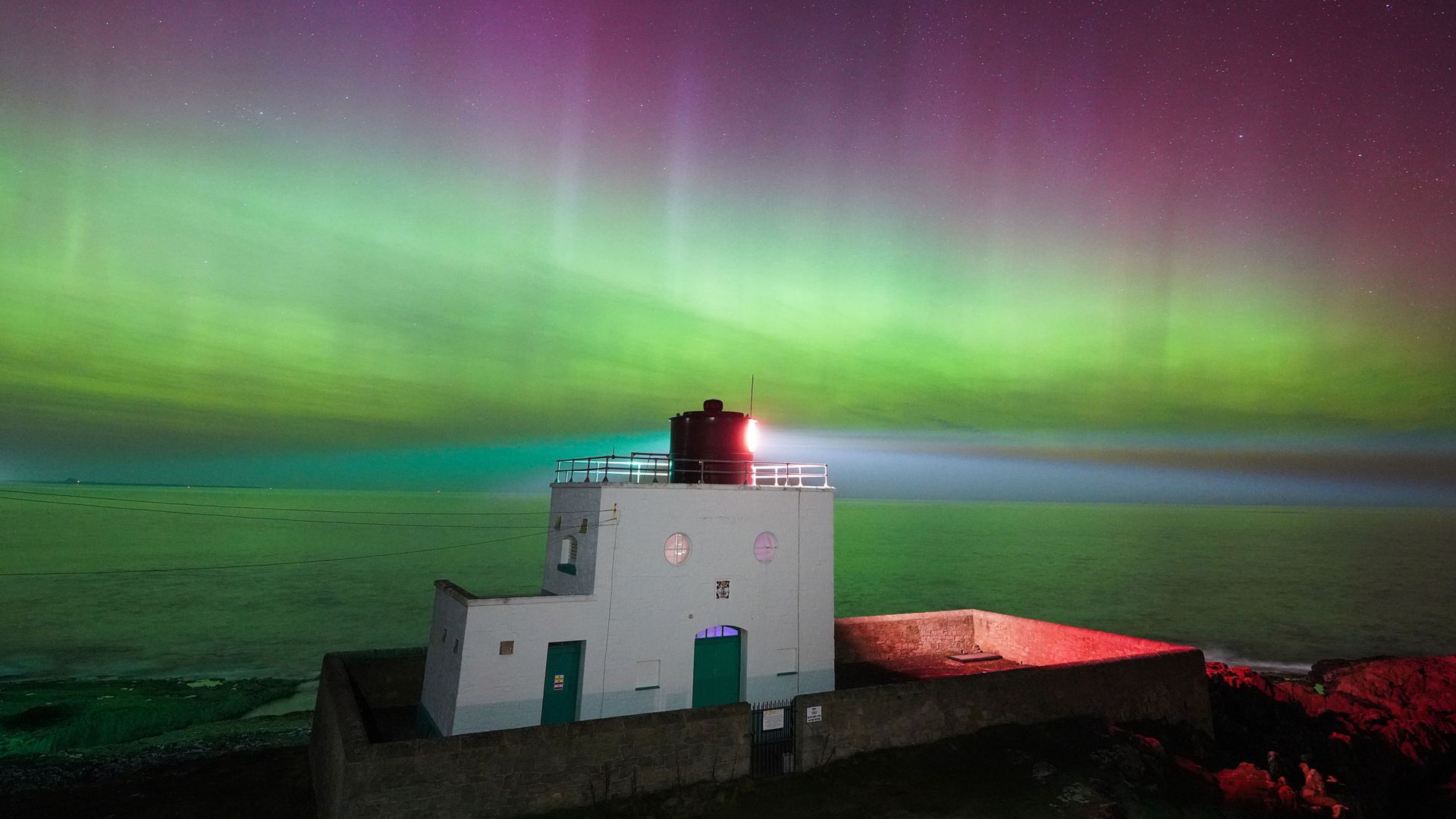
Northern Lights seen across UK forecast to return
#Northern Lights #Aurora Borealis #UK #Solar activity #Celestial phenomenon #Meteorology #Geomagnetic storm #Stargazing
📌 Key Takeaways
- Northern Lights visible across the UK overnight
- More displays forecast for Saturday
- Unusual for UK due to its lower latitude
- Best viewing in areas with minimal light pollution
📖 Full Retelling
🏷️ Themes
Astronomy, Weather phenomena, Celestial events
📚 Related People & Topics

Solar phenomena
Natural phenomena within the Sun's atmosphere
Solar phenomena are natural phenomena which occur within the atmosphere of the Sun. They take many forms, including solar wind, radio wave flux, solar flares, coronal mass ejections, coronal heating and sunspots. These phenomena are believed to be generated by a helical dynamo, located near the cent...
Northern Lights
Topics referred to by the same term
Northern lights most commonly refers to the aurora borealis, a natural light display in Earth's sky.

United Kingdom
Country in northwestern Europe
The United Kingdom of Great Britain and Northern Ireland, commonly known as the United Kingdom (UK) or Britain, is a country in northwestern Europe, off the coast of the continental mainland. It comprises England, Scotland, Wales and Northern Ireland, with a population of over 69 million in 2024. Th...

Aurora
Atmospheric effect caused by the solar wind
An aurora (pl. aurorae or auroras) is a natural light display in Earth's sky, predominantly observed in high-latitude regions around the Arctic and Antarctic. The terms northern lights (aurora borealis) and southern lights (aurora australis) are used in the Northern and Southern Hemispheres respecti...
Entity Intersection Graph
Connections for Solar phenomena:
Mentioned Entities
Deep Analysis
Why It Matters
The Northern Lights being visible across the UK is significant because it's a rare celestial phenomenon typically only seen at higher latitudes. This increased solar activity provides an unusual opportunity for sky watchers across the country to witness this spectacular natural display. The event also highlights the impact of solar activity on Earth's atmosphere and magnetic field, which has implications for satellite communications, power grids, and other technological systems.
Context & Background
- The Northern Lights (Aurora Borealis) are typically visible only at high latitudes, usually above 60°N, which includes places like Scandinavia, Canada, Alaska, and Iceland
- The phenomenon occurs when charged particles from the sun (solar wind) interact with Earth's magnetic field and atmosphere
- Solar activity follows an approximately 11-year cycle, with periods of high and low activity
- The current solar cycle (Solar Cycle 25) began in December 2019 and is expected to peak around 2025
- Strong geomagnetic storms, which can cause the aurora to be visible at lower latitudes, are often associated with coronal mass ejections (CMEs) from the sun
- The UK's latitude means that strong geomagnetic storms are required for the aurora to be visible, which happens infrequently
- Previous notable displays in the UK occurred in 2003, 2015, and 2021 during periods of heightened solar activity
What Happens Next
Meteorologists forecast that the geomagnetic storm activity responsible for the enhanced visibility of the Northern Lights is expected to persist through the weekend. Sky watchers in the UK, particularly in northern regions, should have additional opportunities to witness the phenomenon on Saturday. The activity is likely to diminish as the geomagnetic storm subsides, but there may be further chances in the coming days if solar activity remains elevated. Those hoping to see the lights should seek out locations with minimal light pollution and clear skies, away from urban centers.
Frequently Asked Questions
The Northern Lights occur when charged particles from the sun interact with Earth's magnetic field and collide with gases in our atmosphere, creating colorful displays of light.
Increased solar activity has created a stronger geomagnetic storm, allowing the aurora to be visible at lower latitudes than usual, including the UK.
Areas with minimal light pollution and clear skies are ideal, particularly northern regions of Scotland, Northern Ireland, and northern England.
The geomagnetic storm activity is expected to persist through the weekend, providing additional viewing opportunities, though the intensity may vary.
No, the UK's lower latitude means that strong geomagnetic storms are required for the aurora to be visible, making such displays infrequent occurrences.