
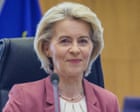
Von der Leyen calls for EU foreign policy to be ‘more realistic and interest-driven’
#Ursula von der Leyen #EU foreign policy #realism #interest-driven #geopolitical strategy #European Union #international relations
📌 Key Takeaways
- Ursula von der Leyen advocates for a shift in EU foreign policy towards realism and interest-driven strategies.
- The call emphasizes aligning foreign policy with the EU's strategic interests rather than purely idealistic goals.
- This approach may signal a more pragmatic stance in international relations and security matters.
- The proposal aims to strengthen the EU's global influence and responsiveness to geopolitical challenges.
📖 Full Retelling
🏷️ Themes
Foreign Policy, EU Strategy
📚 Related People & Topics

Common Foreign and Security Policy
Organised, agreed foreign policy of the European Union
The Common Foreign and Security Policy (CFSP) is the organised, agreed foreign policy of the European Union (EU) for mainly security and defence diplomacy and actions. CFSP deals only with a specific part of the EU's external relations, which domains include trade and commercial policy and funding t...
European Union
Supranational political and economic union
The European Union (EU) is a supranational political and economic union of 27 member states that are located primarily in Europe. The union has a total area of 4,233,255 km2 (1,634,469 sq mi) and an estimated population of more than 450 million as of 2025. The EU is often described as a sui generis ...

Ursula von der Leyen
President of the European Commission since 2019
Ursula Gertrud von der Leyen (German: [ˈʊʁzula ˈɡɛʁtʁuːt fɔn dɐ ˈlaɪən] ; née Albrecht; born 8 October 1958) is a German politician and physician who has served as President of the European Commission since 2019. She served in the German federal government between 2005 and 2019, holding positions in...
Entity Intersection Graph
Connections for Common Foreign and Security Policy:
View full profileMentioned Entities
Deep Analysis
Why It Matters
This statement by European Commission President Ursula von der Leyen signals a potential major shift in EU foreign policy philosophy, moving from a values-based approach toward one prioritizing pragmatic interests. This affects all EU member states' diplomatic relations, trade partnerships, and security arrangements with global powers like China, Russia, and the US. It could reshape how the EU responds to conflicts, economic competition, and human rights issues worldwide, potentially creating tensions between member states with different priorities.
Context & Background
- The EU has traditionally framed its foreign policy around promoting democracy, human rights, and multilateralism since the 1990s
- Recent geopolitical challenges including Russia's invasion of Ukraine, US-China tensions, and Middle East conflicts have exposed limitations of the EU's approach
- Germany's 'Zeitenwende' (turning point) speech in 2022 already signaled a shift toward more pragmatic security policy in response to Russian aggression
- France has long advocated for 'European strategic autonomy' to reduce dependence on US security guarantees
- The EU's Global Gateway initiative represents an earlier move toward interest-driven foreign policy in infrastructure competition with China's Belt and Road
What Happens Next
Von der Leyen will likely develop specific policy proposals ahead of the next European Commission formation in late 2024. Member states will debate this shift at upcoming EU summits, with potential divisions between Eastern European states prioritizing security and Southern European states focusing on economic interests. The approach may be tested in upcoming negotiations with China on trade and with African nations on migration and energy partnerships.
Frequently Asked Questions
It means prioritizing economic, security, and strategic interests over ideological values when making foreign policy decisions. This could involve more pragmatic engagement with authoritarian regimes for trade or security cooperation, even when their domestic policies conflict with EU values.
It could lead to more transactional relations where the EU more aggressively pursues its economic interests, potentially creating trade tensions. However, shared security concerns regarding Russia and China will likely maintain close cooperation on defense matters.
Human rights considerations may become secondary to strategic interests in some relationships, particularly with important trade partners and energy suppliers. However, human rights will likely remain part of EU discourse, especially regarding countries where the EU has less economic dependence.
France and Germany have shown interest in more pragmatic approaches, while Eastern European states may support security-focused realism. Southern European countries facing economic challenges might welcome more flexible engagement with trade partners regardless of political systems.
The EU might become more selective about enlargement, prioritizing strategic value over democratic readiness. Neighborhood policy could focus more on stability and migration control than democratic transformation in partner countries.