
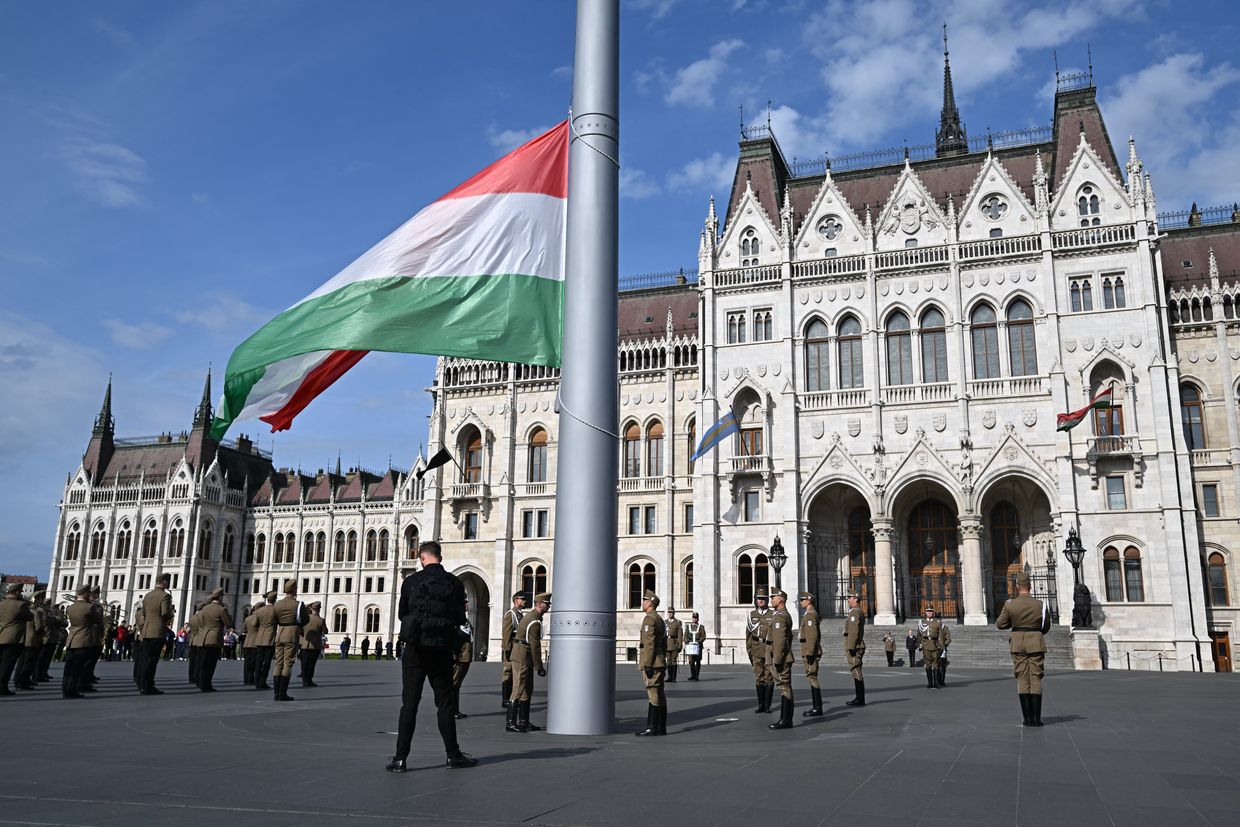
Hungary's parliament passes resolution against Ukraine's EU bid
#Hungary #Ukraine #European Union #membership bid #parliament resolution #political opposition #EU accession
📌 Key Takeaways
- Hungary's parliament passed a resolution opposing Ukraine's bid to join the European Union.
- The resolution reflects Hungary's official stance against Ukraine's EU membership aspirations.
- This move highlights political tensions between Hungary and Ukraine amid broader EU enlargement discussions.
- The decision could influence EU-level debates on Ukraine's accession process.
📖 Full Retelling
🏷️ Themes
EU Enlargement, International Relations
📚 Related People & Topics

Ukraine
Country in Eastern Europe
# Ukraine **Ukraine** is a country located in Eastern Europe. It is the second-largest country in Europe by area, after Russia. Known for its extensive fertile plains, the nation serves as a critical global exporter of grain and is considered a middle power in international affairs. ## Geography a...

European Union
Supranational political and economic union
The European Union (EU) is a supranational political and economic union of 27 member states that are located primarily in Europe. The union has a total area of 4,233,255 km2 (1,634,469 sq mi) and an estimated population of more than 450 million as of 2025. The EU is often described as a sui generis ...

Hungary
Country in Central Europe
Hungary is a landlocked country in Central Europe. Spanning much of the Carpathian Basin, it is bordered by Slovakia to the north, Ukraine to the northeast, Romania to the east and southeast, Serbia to the south, Croatia and Slovenia to the southwest, and Austria to the west. Hungary lies within the...

Enlargement of the European Union
Accession of new countries to the EU
The European Union (EU) has expanded a number of times throughout its history by way of the accession of new member states to the Union. To join the EU, a state needs to fulfil economic and political conditions called the Copenhagen criteria (named after the Copenhagen summit in June 1993), which re...
Entity Intersection Graph
Connections for Ukraine:
Mentioned Entities
Deep Analysis
Why It Matters
This development matters because it represents a significant diplomatic obstacle to Ukraine's European integration ambitions, which have been a central goal since Russia's full-scale invasion. It affects Ukraine's strategic positioning, EU enlargement dynamics, and demonstrates how individual member states can wield veto power over collective decisions. The resolution also highlights growing tensions between Hungary's government and other EU members over foreign policy approaches, potentially weakening European unity on supporting Ukraine.
Context & Background
- Hungary has maintained closer relations with Russia than most EU members since the 2022 invasion, frequently opposing sanctions and military aid to Ukraine
- Ukraine received EU candidate status in June 2022, beginning a lengthy accession process requiring unanimous approval from all 27 member states
- Hungarian Prime Minister Viktor Orbán has repeatedly criticized Ukraine over issues including minority language rights for ethnic Hungarians in western Ukraine
- The EU operates on consensus for major decisions like enlargement, giving any single member state effective veto power over Ukraine's membership bid
What Happens Next
Hungary will likely use this parliamentary resolution as leverage in upcoming EU negotiations, possibly seeking concessions on frozen EU funds or policy compromises. Ukraine will need to address Hungary's specific concerns about minority rights while continuing accession talks with the European Commission. The issue will feature prominently at the next EU summit in December 2024, where member states must decide whether to formally begin membership negotiations with Ukraine.
Frequently Asked Questions
Yes, EU enlargement requires unanimous approval from all member states, so Hungary could veto Ukraine's accession at any stage of the process. However, diplomatic pressure and potential compromises might eventually overcome Hungarian objections.
Hungary primarily cites concerns about the rights of ethnic Hungarians in Ukraine's Transcarpathia region, particularly regarding language education. Budapest also questions Ukraine's readiness for membership and has criticized Kyiv's treatment of Hungarian businesses.
This creates diplomatic complications but doesn't directly impact military operations. However, it weakens Ukraine's political momentum in Europe and could affect long-term security guarantees that would come with EU membership.
Most EU members strongly support Ukraine's European integration, viewing it as crucial for regional stability. Germany, France, Poland and Baltic states have been particularly vocal advocates, though all recognize the accession process will take years.
The EU could attempt to negotiate compromises, potentially offering Hungary concessions on other issues like rule-of-law disputes or frozen funds. In extreme scenarios, there's theoretical discussion about changing decision-making rules, but this would require treaty changes that are politically difficult.