
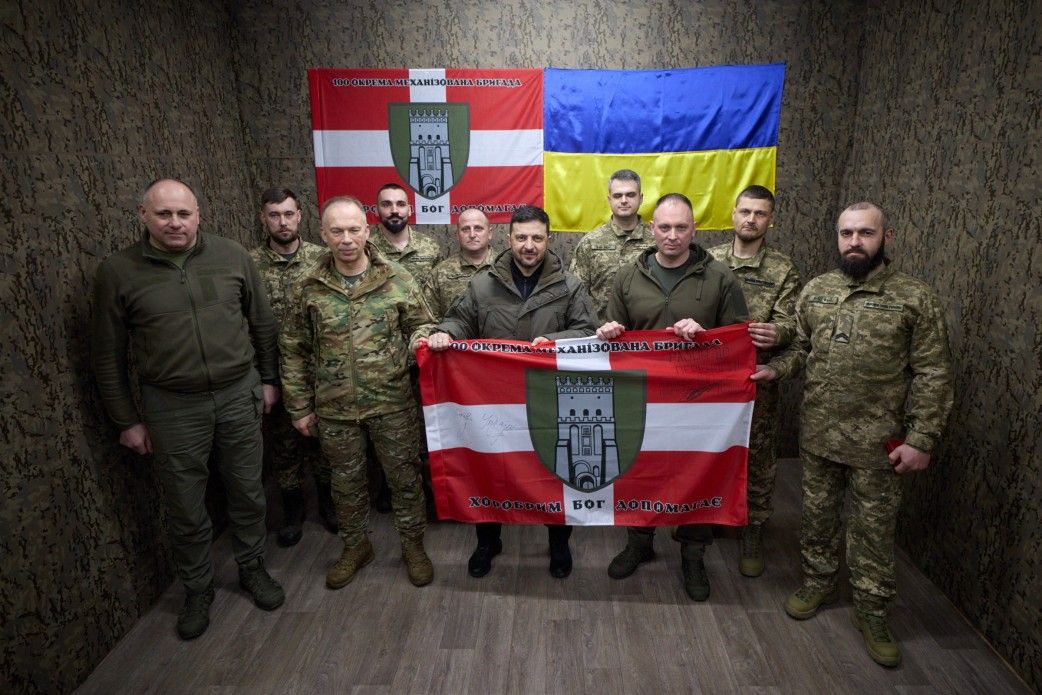
'Russians preparing spring offensive' — Zelensky visits Donetsk Oblast, meets commanders amid risk of new Russian push
#Zelensky #Donetsk Oblast #Russian offensive #spring offensive #Ukraine war #military commanders #frontline
📌 Key Takeaways
- Ukrainian President Zelensky visited frontline Donetsk Oblast to meet military commanders.
- Zelensky warned that Russia is preparing for a new major offensive this spring.
- The visit aimed to assess defensive preparations and boost troop morale.
- Ukrainian forces are fortifying positions amid heightened risk of a Russian push.
📖 Full Retelling
🏷️ Themes
Military Conflict, Frontline Visit
📚 Related People & Topics

Donetsk Oblast
Administrative division of Ukraine
Donetsk Oblast, also called Donechchyna (Ukrainian: Донеччина, IPA: [doˈnɛtʃːɪnɐ]), is an oblast in the Donbas region of eastern Ukraine. About three-fourths (75%) of it is occupied by Russia. Before the Russo-Ukrainian War, it was Ukraine's most populous province, with around 4.1 million residents.
Entity Intersection Graph
No entity connections available yet for this article.
Mentioned Entities
Deep Analysis
Why It Matters
This news matters because it signals potential escalation in the Russia-Ukraine war during a critical period. Ukrainian President Zelensky's frontline visit demonstrates leadership amid intelligence suggesting Russia is preparing a major spring offensive, which could determine territorial control in eastern Ukraine. The situation affects Ukrainian civilians in conflict zones, international security dynamics, and global energy and food markets. Military analysts and NATO allies are closely monitoring these developments as they could influence future Western military aid decisions.
Context & Background
- Russia launched its full-scale invasion of Ukraine in February 2022, with Donetsk Oblast being one of the four regions Russia illegally annexed in September 2022 despite not fully controlling them
- The region has seen some of the war's most intense fighting, including the battles for Mariupol, Bakhmut, and Avdiivka, with Russia making incremental gains in recent months
- Previous Russian spring offensives in 2022 and 2023 resulted in significant territorial changes, though Ukraine's successful 2023 counteroffensive reclaimed some areas in the south
- Donetsk Oblast has been partially occupied since 2014 when Russia first invaded and supported separatist forces in eastern Ukraine
- The timing coincides with delayed U.S. military aid and European debates about increasing support for Ukraine
What Happens Next
Military analysts expect Russia to launch its offensive in late March or April when ground conditions improve. Ukraine will likely focus on defensive preparations while seeking accelerated Western weapons deliveries. NATO may hold emergency meetings to coordinate responses, and the UN Security Council will probably convene as fighting intensifies. The offensive's success or failure could influence Ukraine's negotiating position and future Western support levels.
Frequently Asked Questions
Donetsk Oblast contains critical industrial infrastructure, transportation corridors, and has symbolic importance as one of Russia's claimed annexed territories. Control of this region would give Russia a land bridge to Crimea and consolidate its hold over eastern Ukraine.
Zelensky aims to boost troop morale, assess frontline conditions firsthand, and demonstrate leadership to both domestic and international audiences. The visit also allows direct coordination with military commanders ahead of expected Russian operations.
A successful Russian offensive could pressure Western allies to increase military aid, while Ukrainian resilience might strengthen arguments for continued support. The timing coincides with critical debates in U.S. Congress and European capitals about aid packages.
Ukraine urgently needs artillery shells, air defense systems, and long-range missiles to counter expected Russian assaults. Electronic warfare equipment and mine-clearing vehicles are also crucial for defending against concentrated attacks.
Seasonal offensives have become predictable in this conflict due to weather patterns affecting mobility. While timing predictions are generally accurate, the scale and specific targets of Russian operations remain intelligence assessments subject to change.