📖 Full Retelling
Ayatollah Ali Khamenei's son Mojtaba has emerged as a leading candidate to replace his slain father as Iran's supreme leader in Tehran on March 4, 2026, as regime loyalists promote him as the Islamic republic's next successor following the killing of the 37-year ruler in US and Israel air strikes. Fars news agency, close to the powerful Islamic Revolutionary Guard Corps, indicated that the decision to choose the next leader would likely occur next week after members of Iran's Assembly of Experts—the clerical body responsible for selecting the supreme leader—conducted an online meeting. Regime loyalists immediately took to social media to promote Mojtaba as the chosen successor, with journalist Hatef Salehi publishing a photo of Mojtaba on X and calling in Arabic for God to save 'our leader Imam Khamenei,' while a relative of Khamenei confirmed that while the decision wasn't yet definite, Mojtaba's chances were very high and he was 'slightly ahead' in the decision-making process.
The emergence of Mojtaba as a potential successor comes amid heightened tensions and threats from Israel, which has vowed to eliminate any new Iranian leadership. Israeli Defense Minister Israel Katz explicitly stated on X that every new leader 'will be an unequivocal target for elimination' regardless of their name or location. Israel had previously bombed the Assembly of Experts building in Qom on Tuesday, though Iranian news agencies reported the structure was empty. The current power vacuum exists after Ayatollah Ali Khamenei, who had ruled Iran since 1989, along with his mother, wife, sister, brother-in-law, and niece, were killed in coordinated US and Israel air strikes on the supreme leader's compound. Mojtaba's fate and whereabouts remain unknown since these attacks.
Mojtaba Khamenei, a 56-year-old who has maintained close ties with the Revolutionary Guards while keeping a relatively low public profile, has been viewed within Iranian political circles as a potential successor for nearly two decades, though his exact political role has never been formally defined. Analysts suggest that if Mojtaba assumes power, he could either implement extensive reforms in cooperation with the Revolutionary Guards or continue his father's hardline policies, potentially marking a return to dynastic politics in Iran. Other contenders include Alireza Arafi, a senior cleric on the three-member interim leadership council, and Hassan Khomeini, the grandson of the Islamic republic's founder. Sanam Vakil of Chatham House noted that while Mojtaba has re-emerged as a candidate, his selection would undermine the ideological nature of the regime's non-hereditary system, though current circumstances may force this outcome as competing factions vie for influence in the opaque Iranian political landscape.
📚 Related People & Topics
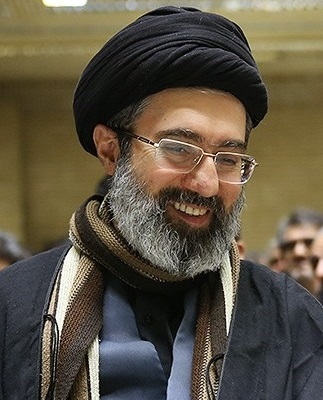
Iranian politician and cleric (born 1969)
Mojtaba Hosseini Khamenei (born 8 September 1969) is an Iranian politician and Muslim cleric. The second eldest child of Ali Khamenei, the former supreme leader of Iran, Mojtaba Khamenei served in the Iran–Iraq War from 1987 to 1988, and also reportedly took control of the Basij that was used to sup...

Iranian governmental body
The Assembly of Experts (Persian: مجلس خبرگان رهبری, romanized: Majles-e Khabargan-e Rahbari), also translated as the Assembly of Experts of the Leadership, is the deliberative body empowered to appoint the Supreme Leader of Iran. All directly elected members must first be vetted by the Guardian Cou...

Transcontinental geopolitical region
The Middle East is a geopolitical region encompassing the Arabian Peninsula, Egypt, Iran, Iraq, the Levant, and Turkey.
The term came into widespread usage by Western European nations in the early 20th century as a replacement of the term Near East (both were in contrast to the Far East). The term ...

