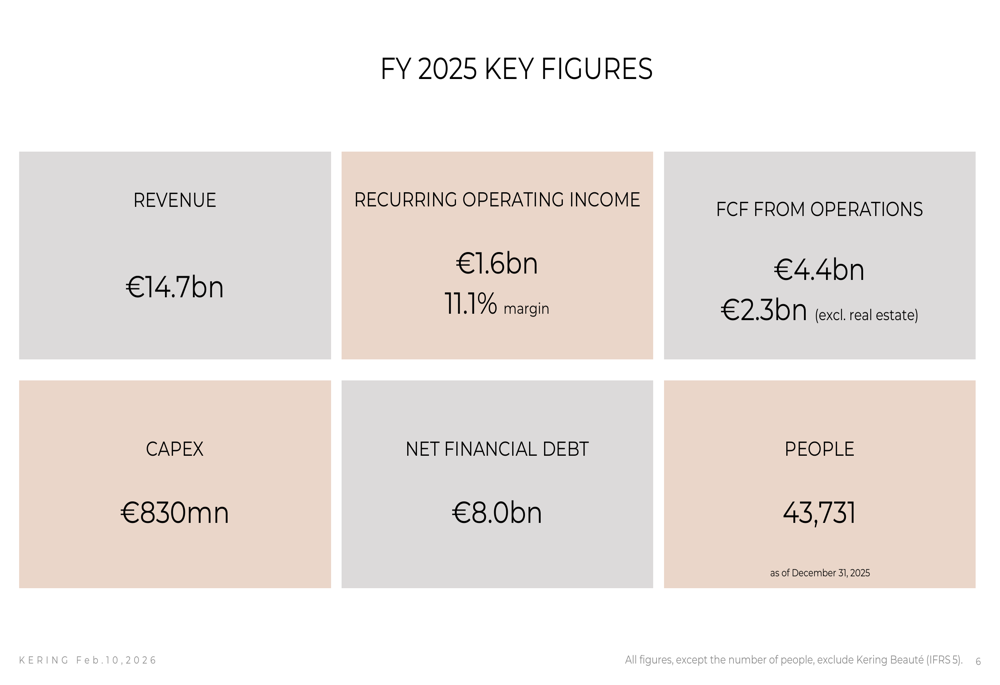
Kering FY 2025 presentation slides: Revenue declines amid strategic restructuring
#Kering #Gucci #Luxury market #Revenue decline #Fiscal Year 2025 #François-Henri Pinault #Financial results
📌 Key Takeaways
- Kering reported a significant revenue decline driven largely by an 18% slump in Gucci's comparable sales.
- The group is pursuing a major strategic restructuring focused on brand elevation and reducing wholesale distribution.
- Asia-Pacific markets showed the most significant weakness, contributing to the overall contraction in luxury demand.
- New investments in Kering Eyewear and Beauty are being prioritized to diversify revenue streams away from traditional leather goods.
📖 Full Retelling
🏷️ Themes
Corporate Finance, Luxury Industry, Strategic Restructuring
📚 Related People & Topics

Gucci
Italian luxury fashion house
# Gucci (Guccio Gucci S.p.A.) **Guccio Gucci S.p.A.**, operating under the brand name **Gucci**, is a premier Italian luxury fashion house headquartered in Florence, Tuscany. Renowned globally for its craftsmanship and influence, the house represents a pinnacle of Italian heritage and contemporary ...

Luxury goods
Good for which demand increases more than what is proportional as income rises
In economics, a luxury good (or upmarket good) is a product or item or service for which demand increases more than what is proportional as income rises, so that expenditures on the good become a more significant proportion of overall spending. Luxury goods are in contrast to necessity goods, where...

Kering
French multinational corporation
Kering S.A. (French: [kɛːʁiŋ]) is a French multinational holding company specializing in luxury goods, headquartered in Paris. It owns the brands Gucci, Yves Saint Laurent, Balenciaga, Bottega Veneta, Creed, Maui Jim, and Alexander McQueen, among others. The timber-trading company Pinault S.A. was f...
🔗 Entity Intersection Graph
Connections for Gucci:
- 🌐 Luxury goods (1 shared articles)
- 🏢 Kering (1 shared articles)
📄 Original Source Content
try{ var _=i o; . if(!_||_&&typeof _==="object"&&_.expiry As Claude disrupts stock market, Anthropic researcher warns ’world is in peril’ Gold, silver prices rise amid U.S.-Iran tensions, blowout January payrolls data Dow halts three-day win streak as blowout jobs data curbs rate cut bets Citi pushes back Fed rate cuts to May after blowout January jobs report (South Africa Philippines Nigeria) Kering FY 2025 presentation slides: Revenue declines amid strategic restructuring Company News Published 02/10/2026, 05:07 AM Kering FY 2025 presentation slides: Revenue declines amid strategic restructuring 0 0IIH -2.91% Introduction & Market Context Kering L unveiled its full-year 2025 results on February 10, 2026, revealing a challenging year marked by revenue declines across most of its luxury brands. Despite reporting a 10% comparable revenue decrease to €14.7 billion, the company’s stock surged 11.49% to close at 290.08 USD, as investors responded positively to cost-cutting measures and strategic restructuring initiatives. The luxury conglomerate, which owns brands including Gucci, Saint Laurent, and Bottega Veneta, has been navigating a difficult luxury market environment while implementing significant operational changes under CEO Luca de Meo’s leadership. Quarterly Performance Highlights Kering’s full-year 2025 revenue reached €14.7 billion, representing a 13% decline on a reported basis and 10% on a comparable basis. The company’s recurring operating income stood at €1.6 billion, yielding an 11.1% margin, while free cash flow from operations reached €4.4 billion, including €2.1 billion from real estate transactions. As shown in the following chart of key financial figures: The revenue breakdown by region showed varying performance, with North America representing 24% of sales (+1 percentage point vs. prior year), Western Europe at 30% (+1pt), Japan at 8% , Asia Pacific at 29% (-2pts), and Rest of World at 9% . The detailed quarterly and full-year performance across b...