
Supreme Court declines to review press freedom case
#Supreme Court #press freedom #journalist arrest #Texas #border agent #suicide #car crash #First Amendment
📌 Key Takeaways
- Supreme Court declines to review a press freedom case from 2017.
- Case involved a journalist arrested in Texas for publishing stories.
- Stories covered a border agent's public suicide and a car crash.
- Decision leaves lower court ruling on the arrest in place.
📖 Full Retelling
🏷️ Themes
Press Freedom, Legal Proceedings
📚 Related People & Topics
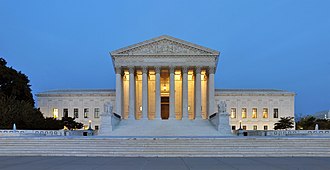
Supreme court
Highest court in a jurisdiction
In most legal jurisdictions, a supreme court, also known as a court of last resort, apex court, high (or final) court of appeal, and court of final appeal, is the highest court within the hierarchy of courts. Broadly speaking, the decisions of a supreme court are binding on all other courts in a nat...

Texas
U.S. state
# Texas **Texas** (/ˈtɛksəs/) is a state in the South Central region of the United States. It is the second-largest U.S. state by both land area and population. Known as the "Lone Star State," it possesses a diverse geography and a major maritime presence. ## Geography and Borders Texas is charact...

First Amendment to the United States Constitution
1791 amendment limiting government restriction of civil liberties
The First Amendment (Amendment I) to the United States Constitution prevents Congress from making laws respecting an establishment of religion; prohibiting the free exercise of religion; or abridging the freedom of speech, the freedom of the press, the freedom of assembly, or the right to petition t...
Entity Intersection Graph
Connections for Supreme court:
Mentioned Entities
Deep Analysis
Why It Matters
This decision matters because it leaves in place a lower court ruling that could weaken First Amendment protections for journalists, potentially chilling investigative reporting on law enforcement and public safety issues. It directly affects journalists, especially those covering sensitive topics like border security or police conduct, who may face legal risks for publishing information obtained from public sources. The case also impacts press freedom broadly, as it sets a precedent that journalists can be arrested for their reporting without immediate judicial review of the constitutionality of such actions.
Context & Background
- The case stems from the 2017 arrest of journalist Priscilla Villarreal in Laredo, Texas, after she published stories based on information from a police source.
- Villarreal was charged with 'misuse of official information,' a felony, though the information she reported—about a border agent's suicide and a fatal car crash—was already public or non-confidential.
- The U.S. Court of Appeals for the Fifth Circuit previously ruled in 2023 that Villarreal could not sue the officers for violating her First Amendment rights, citing qualified immunity protections.
- This arrest highlighted tensions between press freedom and law enforcement authority, particularly in border regions where reporting on immigration and security is contentious.
- Similar cases have arisen nationally, with journalists facing legal threats for publishing leaked or public information, raising concerns about prior restraint and retaliation.
What Happens Next
Journalists and press freedom advocates may push for legislative reforms at state or federal levels to strengthen protections against retaliatory arrests, with potential bills introduced in 2025. Villarreal's civil lawsuit could proceed in lower courts on other grounds, though the Supreme Court's denial limits her First Amendment claims. Future similar cases may emerge, testing the boundaries of qualified immunity and press freedoms, possibly leading to renewed Supreme Court review if circuit splits develop.
Frequently Asked Questions
Priscilla Villarreal was arrested in 2017 for 'misuse of official information' after publishing stories about a border agent's suicide and a car crash, based on tips from a police source, though the information was not confidential.
The Supreme Court often denies review due to procedural reasons, lack of a clear circuit split, or to avoid setting a broad precedent; here, it may have deferred to the Fifth Circuit's ruling on qualified immunity.
It risks chilling investigative journalism by allowing arrests for reporting on public information, potentially discouraging coverage of law enforcement and border issues due to fear of legal retaliation.
Yes, Villarreal may continue her civil lawsuit on other claims, but the Supreme Court's denial limits her ability to challenge the First Amendment violations under qualified immunity protections.
Qualified immunity shields government officials from lawsuits unless they violate clearly established rights; here, it protected the arresting officers, making it harder to hold them accountable.